| . |
| . |
| 1970-79 EQUIPMENT PHOTOS (Page 3) |
| . |
GMC "RTS-II" COACHES – MODEL TH-8203 (Series 03)
| . |
| . |
| WE HOPE YOU'VE ENJOYED OUR 1970'S DSR/D-DOT EQUIPMENT PHOTOS |


© 2009 (PAGE LAST MODIFIED ON 07-26-09 (additions 10-22-11, 09-23-12, 09-30-12, 01-28-13, 04-12-14))
| . |
| . |
All Jim Husing Collection photos are posted with the permission of Mr. James Husing. Any distribution of photos for sale purposes is prohibited.
| Please click-on link to return to the "PHOTO GALLERY" Main Page. |
| . |
| . |
| . |
| GMC "RTS-II" COACHES – MODEL T7W-203 (Series 03) |
| . |
| In 1969, GM Truck & Coach unveiled a sleek, radically different designed experimental prototype bus it named the Rapid Transit Experimental (RTX). This three-axle, fiberglass paneled, low-floor spaceship looking vehicle, built in 1968, was envisioned by General Motors Truck & Coach to be its "bus of the future." In 1970, work began on a new modified RTX prototype known as the RTX + 9", which would evolve into what General Motors would later call its "Rapid Transit Series" coach. In 1971, the Urban Mass Transportation Administration (UMTA) launched its "Transbus" project — an attempt by the Federal Government to develop a new standardized advanced bus design built solely to rigid Federal specifications. Three U.S. bus manufacturers each submitted three prototype buses for Transbus consideration. GM's entry—the three-axle RTS-3T—was submitted in 1972. However, by 1974, after Transbus became bogged down in government red tape, GM revived work on its RTX + 9" and developed an "interim" bus it called the "RTS-II" — a cross between Transbus and the RTX + 9". Demo production on this interim model bus would begin in May 1977. In April 1977, UMTA released new, less rigid, bus design standards for these interim buses, which were to be known as Advanced Design Buses (ADBs). Although the RTS-II began as an interim bus, it achieved permanent status when UMTA decided to abandon its Transbus project in late 1979. |
| . |
GENERAL MOTORS "RTS" (RAPID TRANSIT SERIES) COACHES
| . |
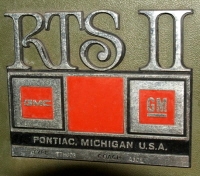
| GMC RTS-II BUILDER'S PLATE This plate was displayed on the front dash step-well of GMC built RTSs. |
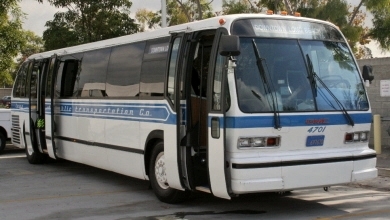
| In August 1977, GMC Truck & Coach in Pontiac, MI would start production on its Rapid Transit Series advanced designed bus, slated for GM's first RTS customer — the Long Beach (CA) Public Transportation Company. Known as the RTS-II (indicating "two" axles compared to the three- axle RTX and Transbus prototypes), it was GM's first redesigned transit bus since 1959. These first generation RTS-IIs (Series 01), Model TH-8201, were built exclusively for a consortium of transit agencies located in California, Massachusetts, and Texas through the spring of 1978. The first RTS, coach #4701, was the first of 15 delivered to Long Beach, CA by October 1977. |
D-DOT (Detroit Department Of Transportation)
| CLICK-ON NEXT FOR OUR 1980'S PHOTO GALLERY |
| . |
GMC "RTS-II" COACHES – MODEL T8H-203 (Series 03)
| . |
| . |
| . |
| .. |
| .. |
| (Video-clip courtesy of the Evan T. McCausland collection) |
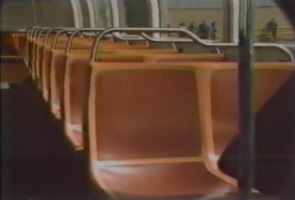
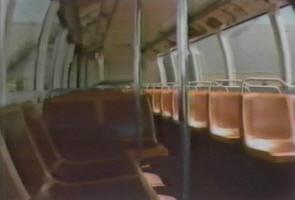
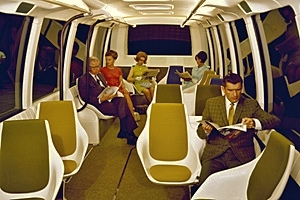
| Top photo: The bucket-seat lounge-like interior of the RTX. Video: RTX featured in this excerpt from a 1968 GMC film. (Photo: Fred Rosvold collection) |
| . |
- RECOMMENDED READING: The only published book devoted to the full in-depth history
of the RTS bus. The author begins with the early (pre-RTS) GM Coach era, then moves on
to the RTS's early development stages under the RTX and the federal "Transbus" project,
then follows the bus as it evolves under its various manufacturers; GMC, TMC, NovaBus, and
Millennium Transit Services. This 160-page paperback book is well illustrated with time-period
photographs, a color photo gallery, and production charts from each of the manufacturers.
of the RTS bus. The author begins with the early (pre-RTS) GM Coach era, then moves on
to the RTS's early development stages under the RTX and the federal "Transbus" project,
then follows the bus as it evolves under its various manufacturers; GMC, TMC, NovaBus, and
Millennium Transit Services. This 160-page paperback book is well illustrated with time-period
photographs, a color photo gallery, and production charts from each of the manufacturers.
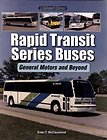
"RAPID TRANSIT SERIES BUSES: General Motors and Beyond" by Evan T. McCausland

"Very well illustrated and a must have for any RTS coach enthusiast. I'm very impressed
with this publication, on what has been my childhood favorite transit bus. Kudos to Evan T.
McCausland." — Karl A. Marshall (D-DOT coach operator)
with this publication, on what has been my childhood favorite transit bus. Kudos to Evan T.
McCausland." — Karl A. Marshall (D-DOT coach operator)
| "Rapid Transit Series Buses: General Motors and Beyond (An Enthusiast's Reference)" (Paperback) by Evan T. Mccausland (Author) - Iconografix (Publisher – May 15, 2008) |

| Beginning in August of 1978, delivery would begin on the remaining 41 coaches of the 111-coach order slated for DDOT. These last coaches (#1370L–1410L) came equipped with rear door hydraulic wheelchair lifts—a first for the city—and were designated by the letter "L". Assigned to the east-side Shoemaker Terminal, these 43-passenger lift-equipped buses would be used as part of a pilot program initiated on the route #34 Gratiot line. Although the cost for the non-lift equipped DDOT RTSs ran $91,000 apiece, the lift would add an additional $9,000 to the cost of the bus. Lift equipped coach #1403L is seen here parked at the DDOT Shoemaker Terminal. [website owner's collection photo, courtesy of the Schramm photo collection] |

| Unfortunately, the RTS was plagued by an array of problems during its infancy, requiring some 15 repairs by GM after the first year; including brake lining, rear door, and electrical system repairs. But despite these problems, the first of 122 more RTS-II Series 03 coaches would soon be on the way. On September 21, 1979, the first of 105 lift-equipped coaches (#1501L–1605L) would begin arriving. Purchased by SEMTA, but leased to the city for $1.00 per year, these 40- foot, 46-passenger coaches (Model designation now changed to T8H-203) allowed DDOT to add wheel-chair accessible service to routes #14 Crosstown, #21 Grand River, and #53 Woodward. [1981 photo courtesy of the Krambles-Peterson archive collection, Art Peterson photo] |
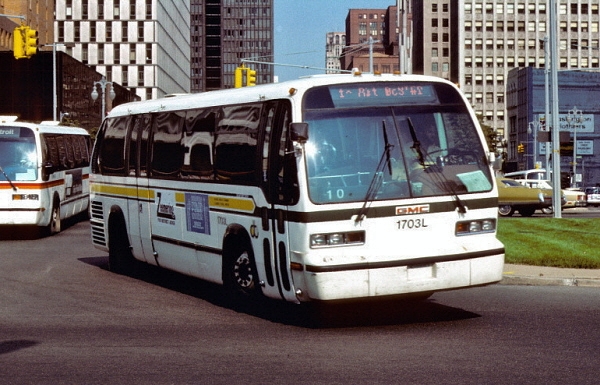
| In early 1980, DDOT began experimenting with the "Transdot" destination sign by testing them on three RTS 35-footers; coaches #1701, 1702 and 1703. In this September 1981 photo, coach #1703L is turning east onto E. Jefferson from Woodward while working the Mini-Loop #1 route. Although the computerized route sign on coach #1703L appears here to be in transition mode, the digital "Transdot" sign on coach #1701L in the previous photo clearly reads: 1 MINIBUS #1. [Melvin Bernero photobucket.com collection, used by permission of Melvin Bernero] |
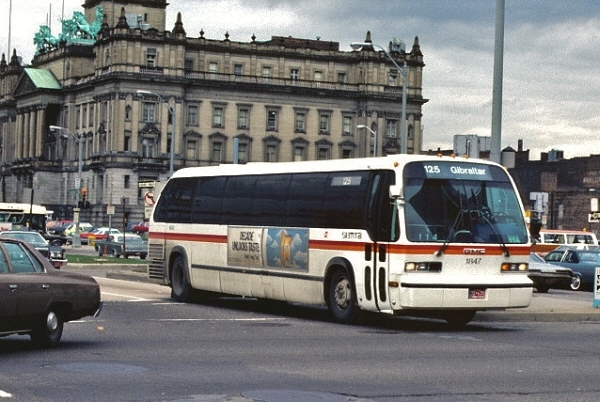
| In August 1977, the Southeastern Michigan Transportation Authority (SEMTA) had placed an order for 189 new GMC RTS coaches at a cost of more than $18.2 million. Funding for the buses was financed 80% by the U.S. Dept. of Trans. and 20% from state grants. SEMTA retained 78 of the buses (#1801-1878) for its suburban operation, while 111 were leased to the city of Detroit for $1.00 a year. Fifty-seven coaches from that order also came equipped with hydraulic wheel- chair lifts—with sixteen (#1863L–1878L) kept by SEMTA for route #560 Gratiot. The SEMTA fleet came equipped with 46 large cushioned seats and no rear exit doors on its non-lift coaches. [Melvin Bernero photobucket.com collection, used by permission of Melvin Bernero] |
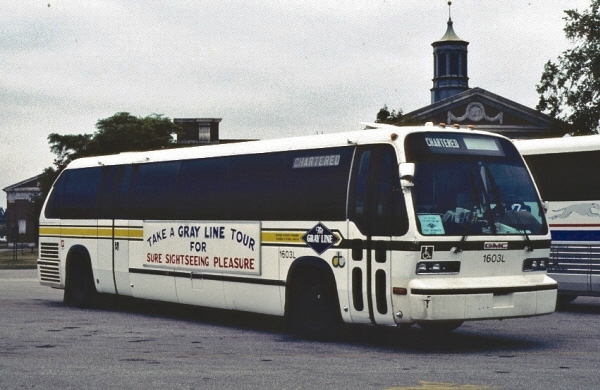
| A number of features unique to the first (1978) RTS fleet—such as the large out-side "elephant- ear" mirrors and a front-door interlock feature—were absent on this second fleet. In the above 1982 photo, it appears that coach #1603L (parked at Greenfield Village in Dearborn, MI) had now been reserved for V.I.P. Chartered Service, including Gray Line Sightseeing Tours. [Edward Gibbs photo, courtesy of Melvin Bernero photobucket.com collection] |
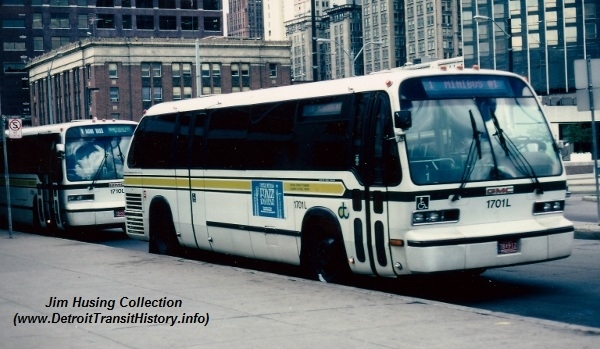
| Also included in that 122-coach order were 17 smaller-size "35-foot" RTS-IIs (#1701L–1717L), which began arriving on November 6, 1979. These 36-passenger coaches, Model T7W-203, were constructed using seven 5-foot modules (instead of the eight used for 40' buses) and came equipped with the smaller six-cylinder 6V-71 Detroit Diesel engine. All seventeen coaches were assigned to the Gilbert Terminal and used on light service lines and downtown mini-bus routes. Although coach #1701L, as seen in this June 1981 photo, is equipped with a "Transdot" digital route sign, the original fleet all arrived with roll-sign curtains, as displayed on rear coach #1710. [Jim Husing Collection photo, courtesy of James Husing — see disclaimer below] |
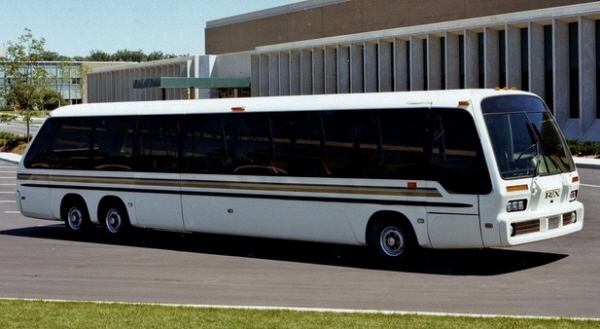
| In 1968, the GMC Truck & Coach engineering staff, along with GM Research Studios, completed work on a sleek, modular design experimental prototype bus known as the RTX (Rapid Transit Experimental). Powered by a 280 hp GT-309 gas turbine engine, this 40-foot long, low-floor, three-axle transit coach — equipped with high-back "lounge-shaped" bucket seats — would become the predecessor to GM's entry into the Federal Government's "Transbus" project, and would later evolve into the GMC two-axle Advance Design Bus (ADB) known as the "RTS-II." [Online photo, source: the Evan T. McCausland collection — Dwight Barnett photo] |
| . |
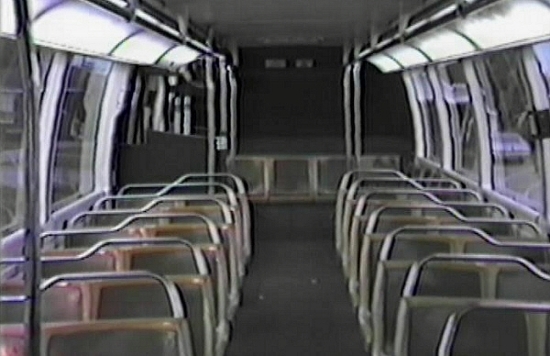
| Although not the best image, this video-still shows the interior rear view of a #1500-1600 series D-DOT RTS-II coach. Just like their predecessors, this fleet also came with those cantilevered wall-mounted fiberglass seats, which, unfortunately, rattled considerably when the coach was empty. In addition to the wheel-chair lift equipment located at the rear door, black was now used on the rear wall panels around the rear seats instead of the white used on the #1300-series. [Video still image captured from website-owner's video tape collection] |
| . |
| . |
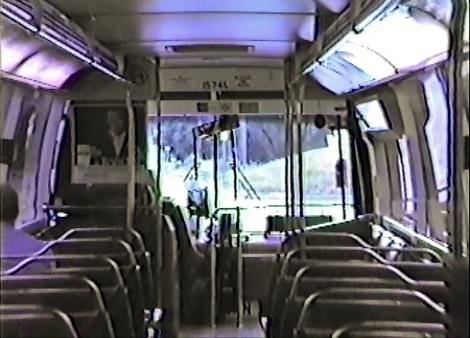
| This August 1981 video still-image shows the interior front view of D-DOT RTS coach #1574L. While all of the interior plastic—including window posts, upper panels, and ceiling—was mostly white, the front dash and floor was a burnt-orange rust color. Beginning with the #1500-series and following, a charcoal color was used on the front windshield posts. On the #1800-series delivered in 1980, a light-gray color replaced the white on the window posts and upper panels. [Video still image captured from website-owner's video tape collection] |
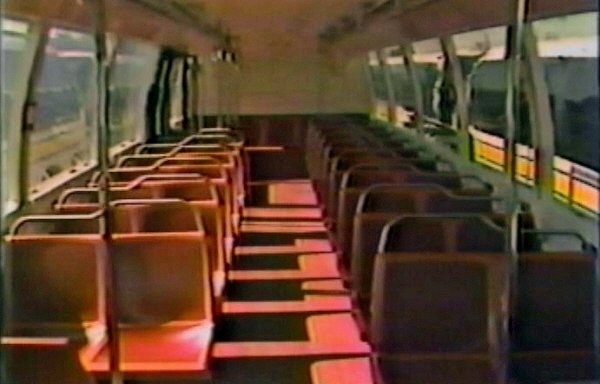
| Instead of the individual plush brightly-colored cushioned seats that were found on the GMC "New-Look" and AM General coaches delivered in 1975, the new GMC RTS-IIs earmarked for DDOT arrived with tough, sturdy, fiberglass/vinyl seats built to withstand vandalism. Because the cushioned seats were often subject to malicious slashing and considerable passenger abuse, these less comfortable seats were installed. [Video images from site-owner's video collection] |
| . |
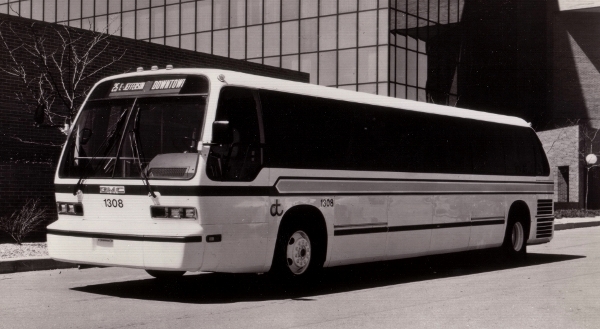
| The RTS coach, at the time it was launched, was noted for its futuristic streamlined styling and large tinted window panels. One advanced feature of the RTS was its modular construction design, where 5-ft long stainless steel modules were welded together to form one complete body. The only notable external identifying feature change on the "Series 03" was the front bumper, which on the Series 01 model was more flush to the body with no place for a front license plate. [GMC promotional photo courtesy of the Carl D. Dutch photo collection] |
| . |
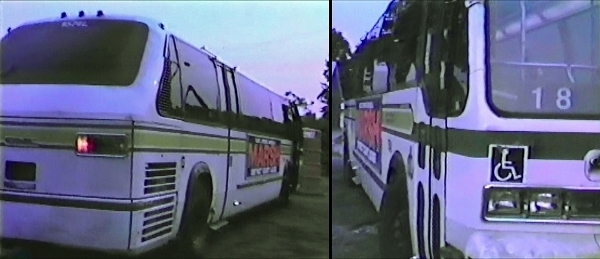
| These video-still images (also from August 1981) show two exterior views of D-DOT RTS coach #1574L. In left photo, the original sloping rear roof-line of the RTS is clearly visible, while a small SEMTA logo decal can be seen displayed next to the transmission access door. In right photo, the old style (manually-turned) run number sign can be seen displayed in the windshield. [Video still images captured from website-owner's video tape collection] |
| (VIDEO TAPE IMAGES) |
| (VIDEO TAPE IMAGE) |
| (VIDEO TAPE IMAGES) |
| (VIDEO TAPE IMAGE) |
| THE 1990's 1 2 3 |
| THE 2010's 1 2 |

| THE 2000's 1 2 |
| . |

| All of the GMC built RTS coaches purchased for DDOT were delivered sporting the original RTS "sloping-back" design, as seen in this 1981 photo of coach #1529L; northbound on Woodward Avenue at Cadillac Square in downtown Detroit. A number of the minor issues affecting GMC's first fleets of RTS-IIs had been resolved by GM in this second order. However, the RTS coach would continue to be plagued by reliability issues, such as suspension and overheating problems and frequent air-conditioning failures—which had to be resolved during the early 1980s by the installation of an improved A/C condenser unit that would greatly alter the coach's appearance. [photo courtesy of the Clifford Kuhl collection, used by permission of Clifford Kuhl] |

| Beginning in the spring of 1978, production would begin on the "first" fleet of second generation RTS-IIs - the Series 03 (there was no Series 02). The first "Series 03" coaches (Model TH-8203) were 70 coaches built for the Detroit Dept. of Transportation (DDOT) — purchased through the Southeastern Michigan Transportation Authority (SEMTA). In this Thursday, April 13, 1978 photo, "SEMTA #1" (future DDOT coach #1300 (serial #001)) is pictured rolling down the assembly line at GMC Truck and Coach in Pontiac, with fleet delivery scheduled to begin in May. [Photo courtesy of the Evan T. McCausland collection] |

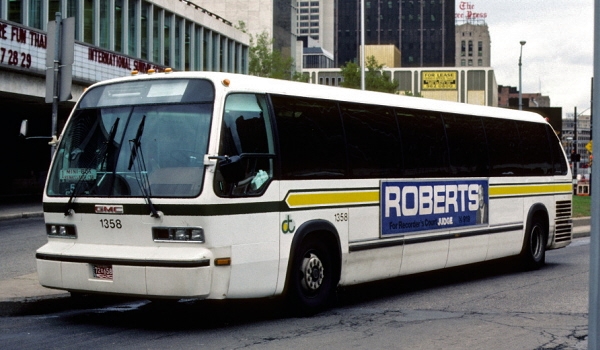
| The first RTS-IIs to begin service in Detroit were 70 D-DOT coaches (#1300-1369) assigned to the Coolidge and Gilbert Terminals, which began service on Monday, June 26, 1978. Many new features included large tinted impact resistant acrylic windows, sturdy fiberglass wall-mounted seats, automatic temperature control, graffiti-resistant fiberglass exterior panels, and a unique "kneeling" feature which permitted the bus to be lowered, making entrance and exit easier for handicapped and elderly persons. These 40' long, 102" wide coaches seated 47-passengers and came equipped with 8V-71 Detroit Diesel engines. Coach #1358 is parked at Cobo Hall in 1978. [Melvin Bernero photobucket.com collection, used by permission of Melvin Bernero] |
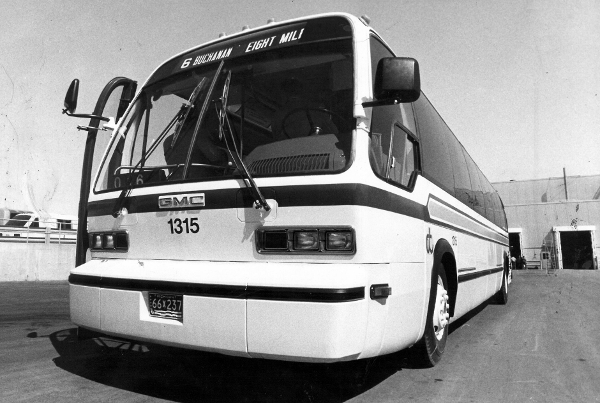
| On May 2, 1978, the first five of 70 new RTS-II coaches were delivered to the Detroit Dept. Of Transportation — the first of an 111-coach order earmarked for Detroit. Coach #1315 was photographed at GMC Truck & Coach during ceremonies held that day honoring the completion of the first five units. The entire SEMTA order would include a total of 189 RTS coaches. [Photo courtesy of the Evan T. McCausland collection] |
| . |
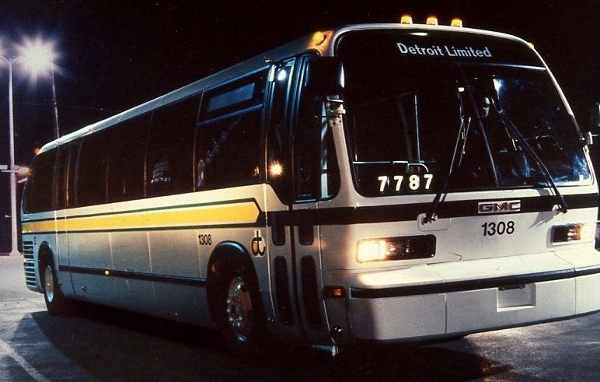
| A night light view of DDOT RTS coach #1308. The odd looking "Detroit Limited" sign displayed in the destination sign window suggests that the roll sign was altered for promotional purposes. [photo source: online – unknown (unidentified) photo collection] |