| . |
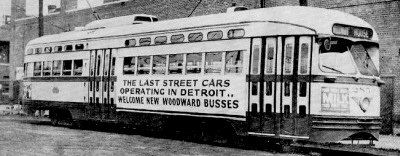
The last streetcar in the parade, and the last to operate over the streets of Detroit, was car #237, which carried members of the Michigan Railroad Club. Around 5:30 p.m., operator Rufus Echols, badge #4192, pulled PCC car #237 into the Woodward Carhouse. The era of nearly ninety-three years of street railway service in Detroit had "officially" come to an end.
| . |
| . |
| . |
| . |
| . |

| For Comments & Suggestions Please Contact Site Owner at: admin@detroittransithistory.info |
| THE P.C.C. ERA IN DETROIT – Part 5 (The Ending of an Era in Detroit and The México City Sale) |
| Click here to return to "THE PCC ERA IN DETROIT" Main Page. |
| For additional information and photos on the streetcar era in Detroit see the publication "Images of Rail - DETROIT'S STREET RAILWAYS" authored by Kenneth Schramm (Arcadia Publishing) |
(Motor Coach Age - May-June 1993), and "DETROIT'S STREET RAILWAYS Vol II: City Lines 1922-1956" (Bulletin 120 - Central Electric Railfans' Association),
and from numerous Detroit Free Press and Detroit News newspaper articles supplied by both Ken Schramm and the Stanley Sycko Collection. The excerpt from
the November, 1956 edition of the Electric Railroaders' Association's "ERA Headlights" (page 2), was sent to the author by Dennis M. Linsky of Brooklyn, NY,
while *the above Philadelphia PTC–NCL information was sent in by Michael T. Greene of Philadelphia, PA.
Virtual Motor City Collection photos #2931 and 2931_4 used by permission of the Walter P. Reuther Library, Wayne State University.
All rights, including those of further reproduction and/or publication, are reserved in full by the Walter P. Reuther Library, Wayne State University. Photographic
reproductions may be protected by U.S. copyright law (U.S. Title 17). The user is fully responsible for copyright infringement.

Meanwhile, by the end of 1954, the entire Detroit PCC fleet had been advertised for sale to a number of PCC operators, but no buyers were found. The MUNI system in San Francisco showed an interest, but turned down the offer because of that city's current financial problems, while the Toronto Transit Commission (TTC) of Toronto, Canada expressed no interest. In late 1954, officials from the Philadelphia Transportation Company (PTC) were interested in the city's first 78 standard-size "all-electric" cars purchased in 1947. However, negotiations were abruptly terminated on March 2, 1955, when Douglas Pratt, a National Cities Lines official, became president of the PTC and terminated talks with the DSR. The Philadelphia company had come under the control of National City Lines, which decided that the PTC go in a more bus-oriented direction.*
| . |

| Car #237, the last car in the procession, carried the banner... "The JOURNEY'S END." While a smaller sign posted just above the banner read... "ADIOS" (Richard F. Glaze photo, source: Detroit's Street Railways Vol II) |
| . |
|


By late 1955, an agreement had been reached between Detroit and Mexico City officials on the purchase of 183 of
the DSR's "all-electric" PCC cars. Initially, Mexico City had offered Detroit $1,098,000 total, or $6,000 apiece, for
each car. But while the DSR and the Common Council continued to argue over the abandonment of rail service, the
Kansas City Public Service Co. influenced the bidding process by also offering its PCCs for sale to Mexico City.
Consequently, Mexico City lowered its Detroit offer to only $699,000, or $4,000 for the first 150 cars and $3,000 for
the remaining 33, after a Kansas City lower offer forced the bidding down. Although the book value for the cars was
around $22,000 each, DSR management felt that they were fortunate to even sell the cars at all, since PCC service
had been declining greatly in recent years, and there was little interest for the cars coming from other U.S. cities.
On Oct. 12, 1955, with Mayor Albert E. Cobo present, the Street Railway Commission accepted Mexico City's
lower offer after the DSR agreed on an additional requirement to increase service on the Michigan and Woodward
lines by 25%. That December, DSR officials announced that a final agreement had been signed between the DSR
and Méxcio City's Servicio de Transportes Eléctricos del Distrito Federal (STE) for the purchase of the 183
available "all-electric" PCCs from Detroit's fleet of 186 cars. The original two demonstrator "air-electric" cars, first
delivered in 1945, were rejected, while car #150 had been wrecked in a collision and was later scrapped.
| . |


| Almost immediately after the sale of Detroit's PCCs to Mexico had been finalized, work began at the Woodward Carhouse and the Highland Park Shops to refurbish and repaint the cars for delivery to the Electric Transport Service of Mexico (STE). In left photo, repainted PCC cars can be seen lined-up at the Woodward Carhouse prior to their delivery to México City. In right photo, rejected "air-electric" cars #101 and #141 (ex-100) are seen being cut-up and scrapped in May of 1956. (Photo source: Dave's Electric Railroads — Stephen M. Scalzo collection photos) |
new upholstery on 77 cars, and $50 per car for loading them on railroad flatcars for shipping. But perhaps the most
troublesome part of the agreement for Detroit, and most advantageous to Mexico City, proved to be the part of the
contract which required the DSR to perform a complete and thorough restoration of each car. While each car
underwent a 72-point inspection by a Mexico City inspector, some of the cars that failed the inspection would require
more than just touch-up work. The end result of this intense inspection resulted in each car looking like a brand
new car before it left Detroit.
This thorough inspection and additional rebuilding escalated labor costs far beyond estimates. City Auditor David
Addy would later inform the Common Council that, "The DSR has spent more money renovating 69 cars than it
will be reimbursed by Mexico City for work on all 183 cars." Because of the higher than expected renovation
costs, it was concluded that the DSR ended up absorbing approximately $500 per car.
Basically, in his zeal to eliminate all rail service from Detroit, DSR General Manager Leo J. Nowicki's proposal for
rail abandonment had expected to realize great savings for the DSR, in both the reduction of operating costs, and
by avoiding considerable track rehabilitation expenses. His plan was based on long-term cost avoidances, but failed
to consider the up-front costs involved in a one-shot sale of all the cars. It was concluded that after all total costs
involved, including depreciation loses, escalated labor costs, pole removal, the cost of new buses, etc.., the DSR
experienced a paper loss with this conversion and sale of about $3.4 million.
After having completely restored and repainted each car with its new cream with green trim paint scheme, the fleet
was renumbered #2102-2140, #2142-2149, and #2151-2286 (with the prefix-number "2" added before the original
car number). The last of the sold PCC cars left Detroit for México City, Mexico on Thursday, July 19, 1956.
edition of ERA Headlights — was sent in by Dennis M. Linsky, a transit enthusiast from Brooklyn, N.Y.
- It was July 19, 1956, when railfans and DSR officials gathered at the Highland Park shops to witness the parting
of Detroit's last PCC car which was bound for Mexico City. Loaded on a Pennsylvania Railroad flatcar was STE
2185 (ex-DSR 185). While newspaper and railfan pictures were taken, at 11:00 A.M., Detroit Terminal Railroad
diesel locomotive 115 made the final pickup of a streetcar from the shops. The same day, all remaining trolley
wire in the abandoned Woodward Car House was removed. All car house trackage has been sold for scrap at
$17,000. It was also disclosed that the DSR hope to realize about $100,000 from the sale of spare PCC parts to
Mexico City's STE which included 4 spare Clark B-2 trucks for the 1949-model PCCs.
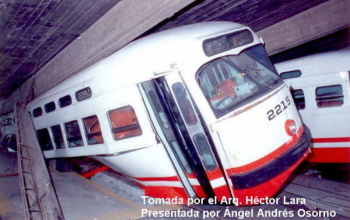
The ex-Detroit PCC cars would continue to operate in México City until the last of that city's tram operation was shut
down temporally in 1984. Sadly, what was left of the remaining former Detroit PCCs came to a tragic end when the
cars were destroyed during a magnitude 8.1 earthquake that struck México City on Sept. 19, 1985. The PCCs were
undergoing restoration when the carbarn at Tetepilco Yards (the STE's main shop) collapsed, crushing the cars.
The earthquake had put an end to nearly 38 years of service from those cars, the first nine of which were in Detroit.
| . |
| |||||||||||||||||||||



 | |  | |  | |  | |  |
| . |
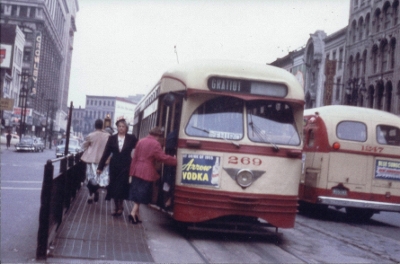
| The above photo, taken on Sept 26, 1955, shows PCC car #269 as it boards passengers along Monroe Street (at Campus Martius) in downtown Detroit during the last months of rail service on the Gratiot route. GM diesel coach #1247 can be seen passing the car's left. In just six months, new GM diesels will take-over operation of the line. (Photo courtesy of the Jim Husing Photo Collection) |


| .. |

| Preserving the History of Public Transportation in and around the City of Detroit, ...from "Steel Wheels to Rubber Tires." |
Shortly thereafter, intense negotiations were under way for the possible early sale of all Detroit streetcars to Mexico City. With the imminent sale of the cars now an almost certainty, the Street Railway Commission, on Sept. 12, 1955, approved a recommendation to liquidate the entire streetcar operation in Detroit during the spring of 1956.
After the Mexico City sale was finalized, orders were placed for 150 GM diesel buses, eighty of which to carry out the conversion of the Gratiot and Woodward operations. General Motors had promised the city that it could deliver ten coaches per day beginning in mid-March.

| PCC streetcars can be seen lining up at the DSR Woodward Carhouse in Highland Park in preparation for an "End of the Line" final parade along Woodward Ave, held on Sunday, April 8, 1956 — the last day of streetcar operation in Detroit. Twenty-four PCC cars would participate in this DSR sponsored final excursion, as Detroiters bid a final farewell to their streetcars. (photo source: online – unknown (unidentified) photo collection) |
At 5 a.m., car #223 made its last northbound trip and arrived at the Fairgrounds Loop at 5:45 a.m. It completed its final run when operator Paul Payne, badge #351, pulled PCC #223 into the Woodward Carhouse at 5:56 a.m., ending streetcar operation on the Woodward line, which dated back to Aug. 27, 1863. The era of a once large and vibrant street railway operation in the city of Detroit had just come to a close. Consequently, with the elimination of its streetcars, the city of Detroit replaced Cleveland, Ohio as the largest U.S. city with an all-bus operation.
| . |
| . |

| PCC car #285 leads a 24-car procession of PCCs south along Woodward Avenue in Highland Park, as nearly 2,000 passengers boarded the cars for that final excursion trip. The photo above looks north along Woodward Avenue, just south of Midland Street, from atop the Detroit Terminal Railroad overpass. As the parade proceeds south, two of the new replacement GM diesel buses can be seen traveling north along Woodward. (Walter P. Reuther Library, Wayne State University photo #2931 — see disclaimer below) |

| . |

| CLICK HERE TO PRINT TEXT–PAGE |
| (Reformatted 09-24-14) |
| During the final two weeks of streetcar operations in Detroit, railfans chartered cars for four excursions on the city's soon departing PCC fleet. On Sunday, March 25, 1956, the Michigan Railroad Club chartered five cars for its last fantrip over the Woodward line and the just abandoned Gratiot line. In the above photo, the five-car caravan is south along Woodward Avenue, between Larned and Jefferson, across from the new City-County Building. Absent from this photo is the Marshall Fredericks' "Spirit of Detroit" monument statue, that wouldn't arrive until 1958. (Walter P. Reuther Library, Wayne State University photo #2931_4 — see disclaimer below) |

| On July 19, 1956, PCC car #2185 (ex-DSR #185) would be the last PCC car to leave Detroit for México City. Now sporting its new cream and green livery, car #2185 has been loaded on a railroad flatcar and ready for pickup by DTRR locomotive #115. (Branford Electric Railway Association Collection photo – Donated by Nathan Nietering) |
| . |
| . |

| On March 25, 1956, streetcar service on Gratiot Ave was discontinued after nearly 93 years of operation. This photo shows PCC car #210, the last streetcar that operated in regular service on the Gratiot line. (Branford Electric Railway Association Collection photo – Donated by Nathan Nietering) |