| . |
| . |

| For Comments & Suggestions Please Contact Site Owner at: admin@detroittransithistory.info |
| THE P.C.C. ERA IN DETROIT – Part 3 (The PCC Streetcar's Service Years in Detroit) |


(to be continued in Part 4, "The Battle for Flexibility and Safety versus Fixed Rail")
DETROIT PCC SERIES: 1 2 3 4 5
DETROIT PCC SERIES: 1 2 3 4 5
Information for the above article was compiled from various articles written by Jack E. Schramm on the Detroit Street Railways, including "Detroit's DSR. Part 3"
(Motor Coach Age - May-June 1993), and "DETROIT'S STREET RAILWAYS Vol II: City Lines 1922-1956" (Bulletin 120 - Central Electric Railfans' Association),
and from numerous Detroit Free Press and Detroit News articles. The 1951 thru 1955 DSR Schedule Analysis and Headway Reports are courtesy of Tom Breeding.
(Motor Coach Age - May-June 1993), and "DETROIT'S STREET RAILWAYS Vol II: City Lines 1922-1956" (Bulletin 120 - Central Electric Railfans' Association),
and from numerous Detroit Free Press and Detroit News articles. The 1951 thru 1955 DSR Schedule Analysis and Headway Reports are courtesy of Tom Breeding.
| Click here to return to "THE PCC ERA IN DETROIT" Main Page. |
| For additional information and photos on the streetcar era in Detroit see the publication "Images of Rail - DETROIT'S STREET RAILWAYS" authored by Kenneth Schramm (Arcadia Publishing) Many of the above photos can be found online courtesy of Dave's Electric Railroads See "Detroit DSR" for more Detroit streetcar photos |
Although the arrival of the PCC streetcar in Detroit during the late 1940s was a giant step forward in the modernization
of the city's remaining street railway operation, their arrival didn't come without some bit of controversy. The operation
of these "one-manned" cars would soon result in increased friction between the DSR and its car men's union.
For the most part, the older Peter Witt streetcars — which the PCC cars were replacing — required a two-man crew
operation, which consisted of a motorman to operate the car and a conductor to collect the fares. The use of the one-
man operated PCC cars would no doubt result in a financial savings for the department, but would on the other hand
threaten the jobs of the platform operators, or conductors. In June of 1947, the department successfully reached an
agreement with Division 26, of the Amalgamated Association of Street, Electric Railway and Motor Coach
Employees of America, to operate the one-man PCC cars on the Woodward line, and to also operate Peter Witt
cars converted over to one-man operation on certain lighter traveled routes. This agreement was contingent upon a
pay increase, and a requirement that the jobs of the conductors with twenty or more years of service be retained.
But not long after the 100% modernization of the Woodward line in 1947, the first curtailment of some PCC operation
would already begin before additional new fleets of PCC's would see service. Beginning Saturday, Oct. 22, 1949, the
Woodward branch extension to the old Detroit and Cleveland Navigation Co. (D&C) boat docks — located at the
foot of Third Street — was discontinued. Previously, every fourth Woodward car would loop to these boat dock piers,
which were located in the vicinity of what is currently Joe Louis Arena. For most of their remaining years of service,
all Woodward cars would now loop near the foot of Woodward at Atwater Street, along-side the Detroit River.
of the city's remaining street railway operation, their arrival didn't come without some bit of controversy. The operation
of these "one-manned" cars would soon result in increased friction between the DSR and its car men's union.
For the most part, the older Peter Witt streetcars — which the PCC cars were replacing — required a two-man crew
operation, which consisted of a motorman to operate the car and a conductor to collect the fares. The use of the one-
man operated PCC cars would no doubt result in a financial savings for the department, but would on the other hand
threaten the jobs of the platform operators, or conductors. In June of 1947, the department successfully reached an
agreement with Division 26, of the Amalgamated Association of Street, Electric Railway and Motor Coach
Employees of America, to operate the one-man PCC cars on the Woodward line, and to also operate Peter Witt
cars converted over to one-man operation on certain lighter traveled routes. This agreement was contingent upon a
pay increase, and a requirement that the jobs of the conductors with twenty or more years of service be retained.
But not long after the 100% modernization of the Woodward line in 1947, the first curtailment of some PCC operation
would already begin before additional new fleets of PCC's would see service. Beginning Saturday, Oct. 22, 1949, the
Woodward branch extension to the old Detroit and Cleveland Navigation Co. (D&C) boat docks — located at the
foot of Third Street — was discontinued. Previously, every fourth Woodward car would loop to these boat dock piers,
which were located in the vicinity of what is currently Joe Louis Arena. For most of their remaining years of service,
all Woodward cars would now loop near the foot of Woodward at Atwater Street, along-side the Detroit River.
| The one-man operated PCC cars were to replace these two-man crew Peter Witt cars on three additional lines, resulting in some union problems for the DSR. (photo courtesy of the S. Sycko collection) |
Meanwhile, more legal problems with the car men's union would
develop upon the delivery of the second fleet of new PCCs in
late August 1949. The union objected to plans to use the one-
man operated PCC cars on three additional heavy lines. This
objection centered around the union's assertion that a prior
agreement prohibited the use of one-man cars on the three
proposed lines. Consequently, the union filed an injunction,
and the Michigan Supreme Court would issue a temporary
restraining order to prevent the DSR from operating the PCC
cars on its Michigan, Gratiot and Jefferson lines. The State
Supreme Court, however, later upheld a previous Circuit Court
ruling which held the contract was invalid because it was never
signed by the Detroit Street Railway Commission.
With its legal issues resolved, the DSR began to place the bulk
of its new larger PCCs into service on the Woodward Avenue
develop upon the delivery of the second fleet of new PCCs in
late August 1949. The union objected to plans to use the one-
man operated PCC cars on three additional heavy lines. This
objection centered around the union's assertion that a prior
agreement prohibited the use of one-man cars on the three
proposed lines. Consequently, the union filed an injunction,
and the Michigan Supreme Court would issue a temporary
restraining order to prevent the DSR from operating the PCC
cars on its Michigan, Gratiot and Jefferson lines. The State
Supreme Court, however, later upheld a previous Circuit Court
ruling which held the contract was invalid because it was never
signed by the Detroit Street Railway Commission.
With its legal issues resolved, the DSR began to place the bulk
of its new larger PCCs into service on the Woodward Avenue
line, beginning Nov. 11, 1949. The older (1947) PCC cars were then transferred over to the three additional lines. By
Dec. 15, 1949, both the Jefferson and Gratiot car lines were 100% PCC operated, with the Michigan line becoming
100% PCC by Jan. 15, 1950. The DSR's fleet of PCCs would now be housed not only at the Woodward Carhouse in
Highland Park, but also at the Gratiot Carhouse at Gratiot and Harper, the Jefferson Carhouse at Jefferson and
St. Jean, and the Wyoming Carhouse at Wyoming and Michigan Avenue in Dearborn.
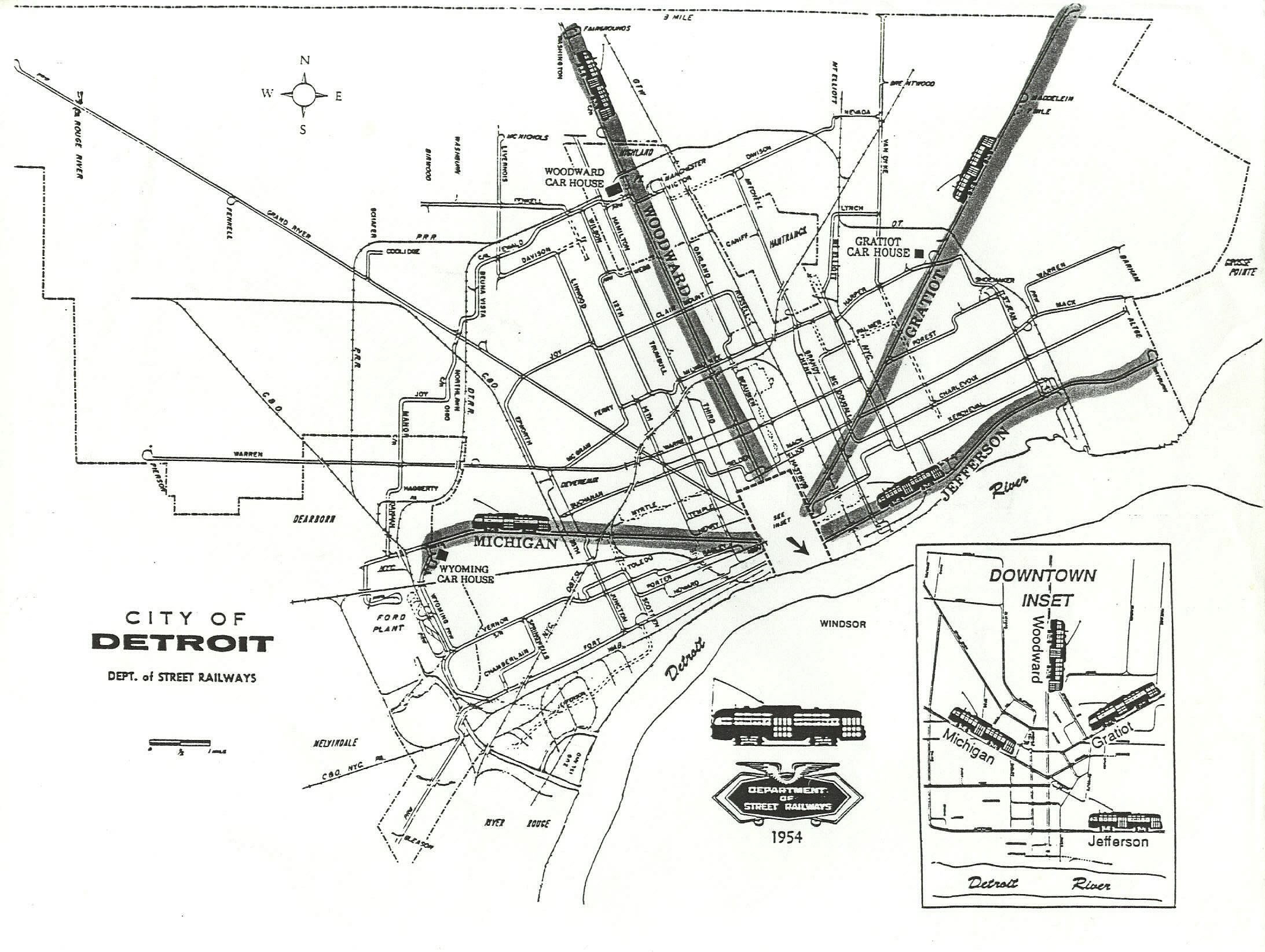
By 1950, a fleet of 186 PCC streetcars operated along the streets of Detroit, providing service on four major routes:
WOODWARD, JEFFERSON, GRATIOT and MICHIGAN. However, beginning on Nov. 13, 1950, the Michigan and
Gratiot lines were consolidated and through-routed into downtown as MICHIGAN-GRATIOT. This newly merged route
resulted in a 16.7 mile one-way distance from Eastwood Park (Gratiot north of 8 Mile) in East Detroit (now Eastpointe)
to the Ford Rouge plant Miller Road Yard (Gate 4) in Dearborn. There was also an attempt to operate PCCs in place
of the two-man Peter Witt cars on the BAKER line on weekends and holidays beginning on Sunday, March 19, 1950.
This experiment, however, was short-lived, after it was discovered that the poor trackage along that route was causing
damage to the car's motor casings. Consequently, the Baker line PCC operation was curtailed shortly thereafter.
Effective Nov. 11, 1951, the Mack streetcar line was converted over to buses, resulting in the Baker line becoming
the last DSR rail line left operating with the older Peter Witt style cars. With only forty or so cars now needed for the
Baker operation, the majority of the Peter Witt cars were sold for scrap. But with the conversion of the Baker line to
buses on April 6, 1952, only the Woodward, Jefferson and Michigan-Gratiot lines were now all that remained of
the city's once large rail operation. However, twenty of the older Peter Witt style cars were retained as a standby fleet.
Dec. 15, 1949, both the Jefferson and Gratiot car lines were 100% PCC operated, with the Michigan line becoming
100% PCC by Jan. 15, 1950. The DSR's fleet of PCCs would now be housed not only at the Woodward Carhouse in
Highland Park, but also at the Gratiot Carhouse at Gratiot and Harper, the Jefferson Carhouse at Jefferson and
St. Jean, and the Wyoming Carhouse at Wyoming and Michigan Avenue in Dearborn.
By 1950, a fleet of 186 PCC streetcars operated along the streets of Detroit, providing service on four major routes:
WOODWARD, JEFFERSON, GRATIOT and MICHIGAN. However, beginning on Nov. 13, 1950, the Michigan and
Gratiot lines were consolidated and through-routed into downtown as MICHIGAN-GRATIOT. This newly merged route
resulted in a 16.7 mile one-way distance from Eastwood Park (Gratiot north of 8 Mile) in East Detroit (now Eastpointe)
to the Ford Rouge plant Miller Road Yard (Gate 4) in Dearborn. There was also an attempt to operate PCCs in place
of the two-man Peter Witt cars on the BAKER line on weekends and holidays beginning on Sunday, March 19, 1950.
This experiment, however, was short-lived, after it was discovered that the poor trackage along that route was causing
damage to the car's motor casings. Consequently, the Baker line PCC operation was curtailed shortly thereafter.
Effective Nov. 11, 1951, the Mack streetcar line was converted over to buses, resulting in the Baker line becoming
the last DSR rail line left operating with the older Peter Witt style cars. With only forty or so cars now needed for the
Baker operation, the majority of the Peter Witt cars were sold for scrap. But with the conversion of the Baker line to
buses on April 6, 1952, only the Woodward, Jefferson and Michigan-Gratiot lines were now all that remained of
the city's once large rail operation. However, twenty of the older Peter Witt style cars were retained as a standby fleet.
To shed some light on the service the PCCs provided during their rather short service life in Detroit, let's take a look at
the service provided on the city's first rail line, E. Jefferson. In 1951, thirty-five PCCs were needed to operate during
peak periods, while fifteen units were needed during the base. Approximately 39,000 passengers used the Jefferson
cars during an average weekday, with schedules operating at a 1½ minute headway during peak hours and a 5-5½
minute headway during off-peak hours. The heaviest rail line, Woodward, required sixty-three PCC cars to operate
during peak periods and thirty-seven during the base. Approximately 70,000 passengers rode the Woodward cars
daily, and schedules called for 1½ minute headways during peak hours and 2½ minutes during midday hours. The
line was also the department's most profit making line citywide, with profits soaring to nearly $95,000 a month.
The following two tables display examples of scheduled PCC weekday operation during Detroit's PCC streetcar era.
the service provided on the city's first rail line, E. Jefferson. In 1951, thirty-five PCCs were needed to operate during
peak periods, while fifteen units were needed during the base. Approximately 39,000 passengers used the Jefferson
cars during an average weekday, with schedules operating at a 1½ minute headway during peak hours and a 5-5½
minute headway during off-peak hours. The heaviest rail line, Woodward, required sixty-three PCC cars to operate
during peak periods and thirty-seven during the base. Approximately 70,000 passengers rode the Woodward cars
daily, and schedules called for 1½ minute headways during peak hours and 2½ minutes during midday hours. The
line was also the department's most profit making line citywide, with profits soaring to nearly $95,000 a month.
The following two tables display examples of scheduled PCC weekday operation during Detroit's PCC streetcar era.
| Between 1947 and 1956, a total of 186 PCC cars operated along the streets of Detroit. In 1947, the heavy Woodward line became the first DSR line to become 100% equipped with PCC cars. The Woodward PCCs would loop at the Detroit River via south on Woodward, west on Woodbridge, south on Griswold, east on Atwater, and then back to Woodward. In this 1953 photo, car #272 heads south along Griswold, preparing to turn onto Atwater Street. The cars would turn along-side the old Vernor's Ginger Ale bottling plant—a former downtown landmark. (Joe Testagrose Collection photo) |
|
Although the DSR now operated with a fleet of the most modern, high performance streetcars of that day, other events
would soon transpire which would change the transit scene in Detroit for decades to come.
would soon transpire which would change the transit scene in Detroit for decades to come.
| |||||||||||||||||||||||||||||||||||||||||||||||||||||||||||||||||||||||||||||||||||||||||||||||||||||||||||||||||||||||||||||||||||||||||||||||||||||||||||||
| ||||||||||||||||||||||||||||||||||||||||||||||||||||||||||||||||||||||||||||||||||||||||||||||||||||||||||||||||||||||||||||||||||
As post-WWII ridership numbers continued to decline during the 1950s, the DSR continued eliminating its rail
operation. Gradual service reductions were also being implemented system wide. The merging of the Gratiot and
Michigan car lines in 1950; the closing of the Jefferson Carhouse in 1951; and the conversion of the Jefferson
line to buses in February, 1954, are all reflected in the following table depicting June, 1954, PCC weekday operations.
operation. Gradual service reductions were also being implemented system wide. The merging of the Gratiot and
Michigan car lines in 1950; the closing of the Jefferson Carhouse in 1951; and the conversion of the Jefferson
line to buses in February, 1954, are all reflected in the following table depicting June, 1954, PCC weekday operations.
| (DSR Schedule Analysis information supplied by Tom Breeding) |
| |||||||||||||||||||||


© 2007 (PAGE LAST MODIFIED ON 05-28-07)
| TO VIEW THE D.S.R. PCC ROSTER LIST CLICK: ROSTER |
 | |  | |  | |  | |  |


| .. |
| The unique website which takes a detailed look back at the History of Public Transportation in and around the City of Detroit. |
