At the end of WW-II, the DSR would again focus on its pre-war campaign to convert the entire operation over to "all-buses" by the early 1950s by purchasing 900 large new coaches and 300 smaller units. To accommodate an expanding motor coach operation, plans were being developed to construct a new bus garage (the future Samuel T. Gilbert Terminal), and to remodel and modernize the now inadequate Coolidge facility. In July of 1947, the first phase of a "city-wide" $6 million terminal modernization program was completed with the addition of new large bus storage bays constructed at the Shoemaker facility. At a project cost of $700,000, this new 91,000-square foot Bus Storage Garage would eliminate a long-time DSR practice of storing coaches outdoors. Automatic coach washing equipment was also added to two bays at the rear of the Gas House Building.
| 7 |
| 6 |
As the DSR began closing some of its older carbarns acquired from the DUR, the Shoemaker Carhouse continued as a major DSR streetcar facility well into the late-1930s. By 1937, the DSR operated a fleet of over 1,300 rail cars housed at seven carhouses, which in addition to Shoemaker included; Baker, E. Jefferson, Gratiot, and Woodward (all inherited from the DUR), and the Coolidge and Wyoming carhouses built by the City of Detroit. However, big changes were soon to come.
In 1937, the DSR operated with a bus fleet of over 1,150 coaches housed at three garages; Kercheval (St. Jean north of Kercheval), Coolidge, and Highland Park. With its motor bus operation expanding rapidly during the late 1930s, the DSR found itself in need of larger facilities to house and service its bus fleet. However, many of the existing carbarns were too old to rehabilitate for bus usage. With plans already in the works to phase out the system's streetcars and to convert the entire DSR operation into an all-bus operation by the early 1950s, the decision was made in 1939 to close the Kercheval Garage (the smallest of the three bus garages) and convert one of the newer carhouses — the much larger Shoemaker Carhouse property — into an "all-bus" facility.
| 5 |
| 2 |
PRE-SHOEMAKER HISTORY:
On April 5, 1920, the voters of the city of Detroit approved the issuance of $15 million in bonds that would allow the city to build and operate its own street railway operation to compete against the privately-owned Detroit United Railway (DUR) company. These bonds were to pay for purchasing 50.73 miles of existing trackage to be seized from the DUR (pending voter approval); the building of 100.25 miles of new track; and the purchasing of 400 streetcars and 150 trailer-cars. One million dollars would be earmarked for carbarn construction, tools, and other equipment.
The following day (April 6, 1920), Mayor James J. Couzens would break ground along Charlevoix Street east of "Connors" (today "Conner") to signal the beginning of construction on the new city-owned system—often referred to as the Municipal Operation (MO). By December, a number of city departments had concentrated their efforts to get the system up and running by the city's projected February 1, 1921 launch date.
Meanwhile, with track and overhead construction now underway, a fleet of 250 streetcars were purchased for the new system. To accommodate these new cars, the city would purchase 17.7-acres of farm-property on the city's east-side (including a farmhouse and barn), bounded by St. Jean, Shoemaker, Lillibridge and E. Warren streets. Permanent brick structures, including a streetcar maintenance barn, an office building, and a main headquarters complex, were all to be constructed on this site. In the mean time, however, a temporary maintenance shed was hurriedly erected on the same location, with temporary tracks installed, which was completed in late January 1921, just in time for the new system to begin operations.
| THE HISTORY OF THE SHOEMAKER PROPERTY |

| The Shoemaker property is seen here not long after having been converted into a bus garage in 1939. The above photo looks southward across the property, with two of the earlier buildings visible in the background; a 1929 built (242-ft) multi-use storage building (left–demolished c.1977) and the heating plant (right–demolished in 2011). (Walter P. Reuther Library, Wayne State University photo #29984_1 — see disclaimer below) |


| To launch bus operations at the Shoemaker facility the property had to be adapted for bus usage. A new Gas House building (visible in photo) was constructed adjacent to the former streetcar maintenance building. In May of 1988, DDOT would convert this Gas House building into a new Bus Rehabilitation Center. (Walter P. Reuther Library, Wayne State University photo #29984 — see disclaimer below) |
| This August 6, 1946 photo shows the initial ground breaking for a new large bus storage bay building; the first phase of a DSR terminal modernization program. An addition was also added to the right two fueling bays at the rear of the Gas House building (far right building) to accommodate automatic coach washing equipment. (Photo source: press release media photo courtesy of eBay) |
To service the new trolley-coach fleet, a new 8,950-square foot Trolley Coach Garage was constructed in 1949, just to the south of the Heating Plant building. Two service pits, two hydraulic hoists, a stock room and a maintenance office were included in the new building. Although the property could now accommodate up to 100 trolley-coaches, only 30 were ever housed there, as plans for a network of electric bus lines were soon scrapped when DSR management decided during the mid-1950s to replace their entire fleet with GM diesel-powered buses. Consequently, trolley-coach service on the Crosstown line was eventually discontinued on March 31, 1961.
| .. |
|


After the trackless trolley-coaches on the Crosstown line were discontinued in 1961, the Shoemaker facility would once again convert to an all-bus operation and the Trolley Coach Garage would become the property's primary maintenance facility. Aside from three additional automatic coach washer lanes being added onto the Gas House Building in 1957, and the abandoning of the administration office building in 1972, most of the property would remain unchanged through the remaining DSR years. The following photos picture the Shoemaker Terminal property as it appeared back in 1968...
| . |
| ||||||||||||||||


| .. |

| Click here to return to "THE D-DOT YEARS" Main Page. |

| For Comments Please Contact Site Owner at: admin@detroittransithistory.info |
 | |  | |  | |  | |  |

| This 1963 photo looks east along Shoemaker Ave.—between St. Jean and Lillibridge streets—along the north end of the then DSR Shoemaker property. In addition to the Shoemaker storage, maintenance, and office facilities that occupied most of the property, the location was also home to the DSR's former Administration Office Building at 11200 Shoemaker Avenue. (Walter P. Reuther Library, Wayne State University photo #48410 — see disclaimer below) |
| .. |
| 1 |
| EARLY (PRE-DSR) SHOEMAKER CARHOUSE PHOTO – 1921 |
| 3 |
Under the DDOT years, a number of major renovations would be preformed at the Shoemaker Terminal complex. The first, begun in 1977, involved a complete renovation of the terminal office building, and a new 90,000-square foot vehicle maintenance complex constructed along the south end of the property. The new Shoemaker Full-Service Coach Center officially opened on June 16, 1979. At a cost of $4.6 million channeled through the regional transit authority SEMTA, this large state-of-the-art facility was designed to fuel, wash, and repair 350 coaches per day. The facility included such ultra modern features as sonically operated coach washers with doors that opened automatically at the end of the wash cycle; large cyclone [vacuum] bus cleaners that also expelled filtered heated air to warm the building; and a (never used) Keene Coin System. The elimination of service pits and the absence of roof support beams along the garage floor center, along with carbon monoxide and smoke detectors, and vastly improved interior lighting, made the center at the time one of the most advanced of its kind in the country.
On May 17, 1988, DDOT would officially open its new Coach Rehabilitation Center after transforming the former Shoemaker Gas House building into a bus rehab facility, where bus bodies were repainted and repaired. Dedicated as part of the local celebration of National Transportation Week (May 15-21), it was hoped at the time that the center would provide for complete coach rebuilding capability and minimize the need to hire outside firms to do the work. In 1995, the DDOT Rehab Center was used to repaint thirty-three #3200-series NovaBUS RTS coaches acquired from SMART. More recently, as part of a Shoemaker reconstruction project, a bus frame straightening machine was added to the "Rehab" facility.
| . |


On Saturday, January 14, 2012, the Shoemaker Terminal facility reopened for business. Photos and results of the reconstruction project will be covered on this site at a later date.
All rights, including those of further reproduction and/or publication, are reserved in full by the Walter P. Reuther Library, Wayne State University. Photographic
reproductions may be protected by U.S. copyright law (U.S. Title 17). The user is fully responsible for copyright infringement.
Lines 1922-1956" by Schramm, Henning and Dworman (Bulletins 117 & 120 – Central Electric Railfans' Association); from Motor Coach Age magazine
articles "Detroit's DSR, Parts 1 thru 3" written by Jack E. Schramm; and from miscellaneous articles posted at Tom's Trolley Bus Pix — Detroit. The
September 6, 1950 DSR Schedule Analysis & Headway Reports courtesy of Tom Breeding. Additional info obtained from "AN EVALUATION STUDY OF
THE PROPERTIES AND OPERATIONS OF DEPT. OF STREET RAILWAYS." (Nov. 1970), and misc. DOT LINES publications (1977–1980 editions).
- FORMER D.S.R CARBARNS & BUS GARAGES
THE COOLIDGE TERMINAL
THE SAMUEL T. GILBERT TERMINAL (coming later)
THE HIGHLAND PARK TERMINAL (coming later)
THE WYOMING TERMINAL


| SHOEMAKER COACHES: Two fleets of DDOT coaches were assigned exclusively to the Shoemaker Terminal during their entire service lives. During the mid-1970s, the entire fleet of fifty-one AM General coaches (#1201-1251) (left photo) were assigned to the Shoemaker Terminal, while the same held true for the fleet of fourteen Neoplan articulated coaches (#8900-8913) (right photo) that were delivered in the fall of 1989. (top photo: courtesy of Schramm collection — left photo: Melvin Bernero photo — right photo: M. Koprowicz photo) |
| . |

| CLICK HERE TO PRINT TEXT–PAGE |
| (Reformatted 07-04-14) |

| This 1921 photo looks south across a fleet of small single-truck Birney cars parked along temporary tracks while construction was being done on the permanent buildings. The farmland purchased for this site was located within territory recently annexed to Detroit in 1918 that was previously known as the village of St. Clair Heights. A number of the homes visible along Lillibridge Street in background are still standing today. (DSR Files photo) |

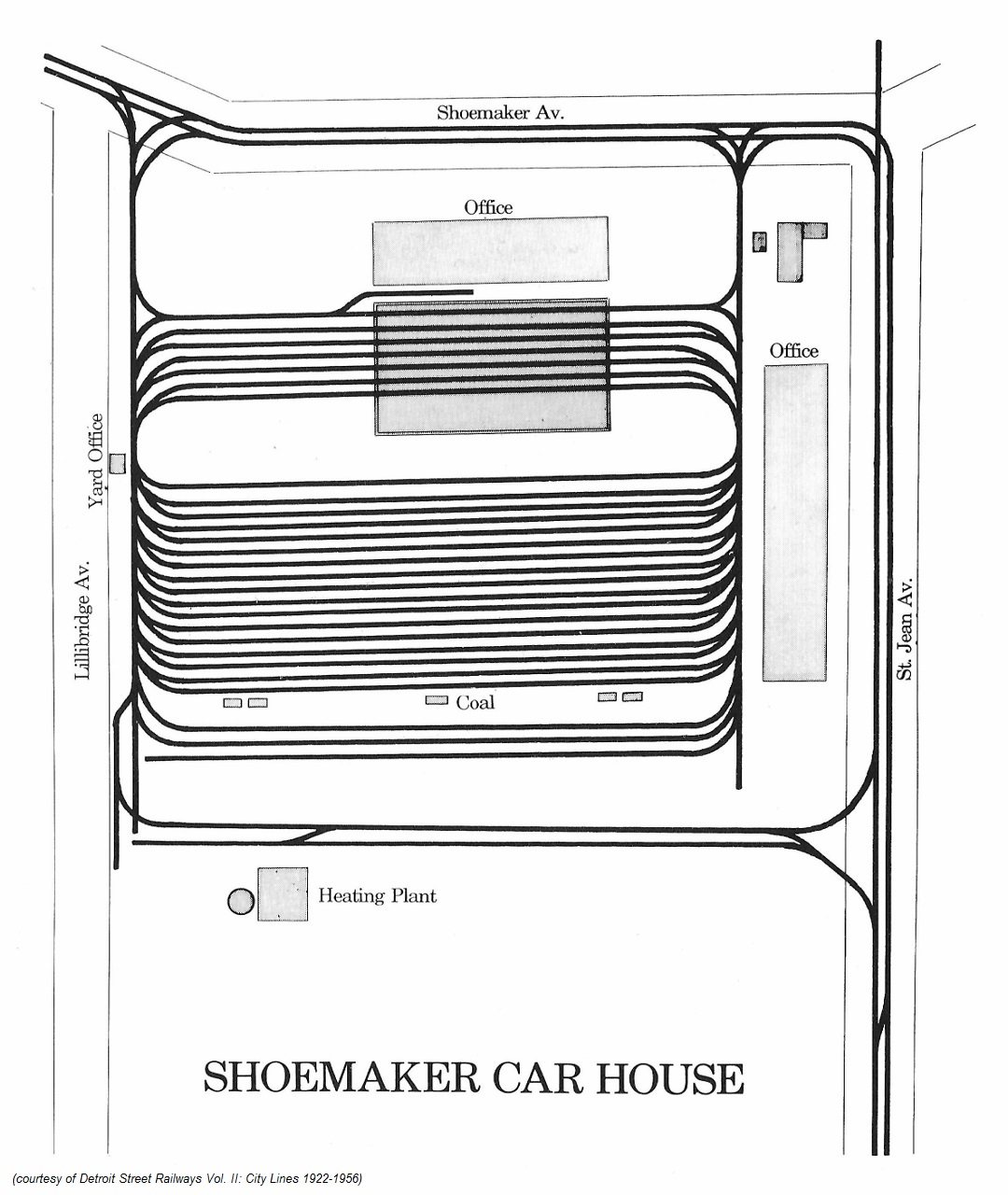
| The layout of the Shoemaker Carhouse property when opened in 1922. The original buildings included the DSR Administration Office Building, the Streetcar Maintenance Garage, a Heating Plant, a Yard Office, and the Shoemaker Carhouse Office Building along St. Jean Street. (courtesy of Detroit Street Railways Vol. II: City Lines 1922-1956) |
| Preserving the History of Public Transportation in and around the City of Detroit, ...from "Steel Wheels to Rubber Tires." |
| (Click-on photo to view larger image) |

| When the City of Detroit entered the street railway business in 1921, two style of streetcars were purchased by the city; the small single-truck Birney Safety Cars (left) and the larger Peter Witt cars (right), both pictured here at the Shoemaker property. The Shoemaker Carhouse office building is also visible in the distant background in the left photo, taken in 1922. (left photo: press release photo courtesy of eBay – right photo: Schramm Collection photo) |
| . |
(NOV. 1970)

| The Shoemaker Terminal was the first DDOT terminal to receive new coaches equipped with hydraulic wheelchair lifts. A fleet of 41 GMC built RTS-IIs (#1370L-1410L) were delivered beginning in August 1978 and used exclusively on the #34 Gratiot line beginning Sept. 17, 1979. Also note the streetcar rails still in the pavement exiting the former streetcar maintenance barn when this circa 1978 photo was taken. |
| . |

| A wide-angle street view of the recently reconstructed Shoemaker Terminal property while looking north along St. Jean St. (Google Maps image) |
Terminal buildings – prepared as part of an evaluation
study done in 1970 to determine the value of the DSR.
| |||||||||||||||||||||||||||||||||||||||||||||||||||||||||||