| . |
| . |
| DETROIT'S GRAY LINE SIGHTSEEING TOURS |
| . |
GRAY LINE HISTORY:
According to "www.grayline.com" (the official web-site of Gray Line Worldwide), it all began back in March of 1910,
after a young restaurateur named Louis Bush decided to refurbish an old Mack Truck chassis, painted it blue and
gray, then began offering sightseeing tours around the city of Washington, D.C. Little did Bush realize, that his early
endeavors would later help to establish the world's leading sightseeing guided tour company, Gray Line Tours.
By 1926, Gray Line had expanded to other booming American cities including New York, Chicago, Detroit, New
Orleans, Los Angeles and San Francisco, and would even spread internationally to Toronto and Havana. Following
World War II, a former Gray Line employee named Harry J. Dooley managed to acquire the company, and helped to
re-establish Gray Line Chicago. Harry Dooley soon became the president of Gray Line, and is today considered by
many to be the father of the sightseeing industry.
Dooley expanded Gray Line's market throughout the United States beginning in the late 1940s, and also established
Gray Line companies in Canada, Mexico, Hawaii and Puerto Rico. The sudden popularity and growth in motorcoach
sightseeing helped to position Gray Line Tours as the leader in the sightseeing industry for decades to follow.
DETROIT GRAY LINE SERVICE:
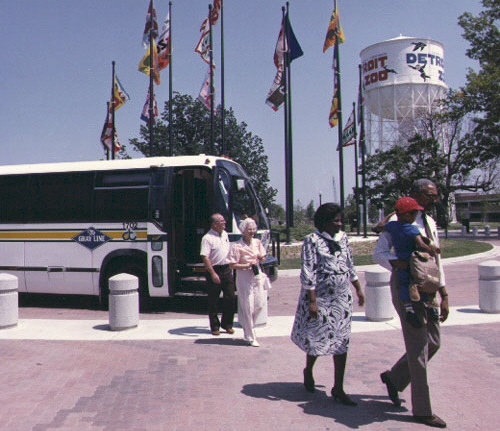
Since 1933, the DSR had become the sole Gray Line franchise operator in the city of Detroit. Scheduled tours would
run from June through September. As a part of the DSR's Chartered Service Division, the Gray Line Sightseeing
Tours provided thousands of camera-snapping tourists from all across the world, who yearly literally poured into the
Industrial Capital of the World, a chance to "see the town." Guided Gray Line tours included visits to such popular
places of interest as: Greenfield Village, the Ford Rouge plant (and the Ford Rotunda), the Art Center, the New Center
area, Belle Isle, across the Ambassador Bridge, through Windsor, Canada, and the Detroit-Windsor Tunnel. During
the early years, the tour buses would leave Grand Circus Park before making their rounds to the leading downtown
hotels to pick up tourists for the various tour routes. During the 1960s, that first stop was moved to the new Cobo Hall.
Special-trained "professional-looking" DSR coach operators were used as the tour guides along the specially selected
routes designed to let riders see the most and best of the "Motor City." According to the August-September 1955
edition of "The DSR Reporter" (an employee monthly publication), each Gray Line operator has to remember a
multitude of facts about each of the spots along each route...
"...Such as the tidbit of knowledge that the Fisher Building is built of 40 different kinds of European
and domestic marbles."
Each Gray Line operator's ultimate goal is to give visiting tourists a pleasant view of Detroit to take back home.
According to "www.grayline.com" (the official web-site of Gray Line Worldwide), it all began back in March of 1910,
after a young restaurateur named Louis Bush decided to refurbish an old Mack Truck chassis, painted it blue and
gray, then began offering sightseeing tours around the city of Washington, D.C. Little did Bush realize, that his early
endeavors would later help to establish the world's leading sightseeing guided tour company, Gray Line Tours.
By 1926, Gray Line had expanded to other booming American cities including New York, Chicago, Detroit, New
Orleans, Los Angeles and San Francisco, and would even spread internationally to Toronto and Havana. Following
World War II, a former Gray Line employee named Harry J. Dooley managed to acquire the company, and helped to
re-establish Gray Line Chicago. Harry Dooley soon became the president of Gray Line, and is today considered by
many to be the father of the sightseeing industry.
Dooley expanded Gray Line's market throughout the United States beginning in the late 1940s, and also established
Gray Line companies in Canada, Mexico, Hawaii and Puerto Rico. The sudden popularity and growth in motorcoach
sightseeing helped to position Gray Line Tours as the leader in the sightseeing industry for decades to follow.
DETROIT GRAY LINE SERVICE:
Since 1933, the DSR had become the sole Gray Line franchise operator in the city of Detroit. Scheduled tours would
run from June through September. As a part of the DSR's Chartered Service Division, the Gray Line Sightseeing
Tours provided thousands of camera-snapping tourists from all across the world, who yearly literally poured into the
Industrial Capital of the World, a chance to "see the town." Guided Gray Line tours included visits to such popular
places of interest as: Greenfield Village, the Ford Rouge plant (and the Ford Rotunda), the Art Center, the New Center
area, Belle Isle, across the Ambassador Bridge, through Windsor, Canada, and the Detroit-Windsor Tunnel. During
the early years, the tour buses would leave Grand Circus Park before making their rounds to the leading downtown
hotels to pick up tourists for the various tour routes. During the 1960s, that first stop was moved to the new Cobo Hall.
Special-trained "professional-looking" DSR coach operators were used as the tour guides along the specially selected
routes designed to let riders see the most and best of the "Motor City." According to the August-September 1955
edition of "The DSR Reporter" (an employee monthly publication), each Gray Line operator has to remember a
multitude of facts about each of the spots along each route...
"...Such as the tidbit of knowledge that the Fisher Building is built of 40 different kinds of European
and domestic marbles."
Each Gray Line operator's ultimate goal is to give visiting tourists a pleasant view of Detroit to take back home.
Although the City of Detroit would hold onto the Gray Line franchise for nearly 70 years, there was a period
beginning in 1942 when the service was suspended during World War II by orders of the Office of Defense
Transportation in order to conserve gasoline and rubber for the war effort. After the service was resumed in 1946, it
appears the DSR attempted to relieve itself of some of the Gray Line responsibilities by contracting with a private
company to act as its agent in the operation of sightseeing service. In June of 1946, the DSR entered an agreement
with the Detroit Sightseeing Company to assume the cost of repainting and preparing the coaches for Gray Line
service, and handle the selling and promotion of the service. In addition, the company would pay the department
coach rental and mileage charges, and a franchise rental of 10% of the gross revenue. But according to the 1947
Journal of the Detroit Common Council, some council members felt that the service should be performed solely by the
DSR and not in connection with a private concern. As a result, a resolution was proposed by Councilman Patrick V.
McNamara revoking the Detroit Sightseeing Co. agreement, effective 180 days after Jan. 1, 1948. Consequently,
Gray Line service was returned to the control of the DSR's Chartered Service Division.
Through the years the DSR reserved a variety of standard transit buses to operate its Gray Line service. During the
early years, coaches were painted in a special Gray Line color scheme, and were reserved for Gray Line sightseeing
operation. With the arrival of the DSR's first fleet of GMC "new-look" coaches in 1960, ten coaches were designated
for use on Gray Line and chartered service operation, but maintained their DSR green, cream and silver color paint
scheme. Although the first ten coaches (#1601-1610) were air-conditioned and lettered, "GRAY LINE SIGHTSEEING
TOURS," they were not specifically utilized solely for Gray Line sightseeing operation. During the DDOT years the
coaches used for Gray Line operation would also maintain the department's current paint scheme, but the trademark
diamond-shaped Gray Line blue logo decal would always be visible across the exterior of the coach.
beginning in 1942 when the service was suspended during World War II by orders of the Office of Defense
Transportation in order to conserve gasoline and rubber for the war effort. After the service was resumed in 1946, it
appears the DSR attempted to relieve itself of some of the Gray Line responsibilities by contracting with a private
company to act as its agent in the operation of sightseeing service. In June of 1946, the DSR entered an agreement
with the Detroit Sightseeing Company to assume the cost of repainting and preparing the coaches for Gray Line
service, and handle the selling and promotion of the service. In addition, the company would pay the department
coach rental and mileage charges, and a franchise rental of 10% of the gross revenue. But according to the 1947
Journal of the Detroit Common Council, some council members felt that the service should be performed solely by the
DSR and not in connection with a private concern. As a result, a resolution was proposed by Councilman Patrick V.
McNamara revoking the Detroit Sightseeing Co. agreement, effective 180 days after Jan. 1, 1948. Consequently,
Gray Line service was returned to the control of the DSR's Chartered Service Division.
Through the years the DSR reserved a variety of standard transit buses to operate its Gray Line service. During the
early years, coaches were painted in a special Gray Line color scheme, and were reserved for Gray Line sightseeing
operation. With the arrival of the DSR's first fleet of GMC "new-look" coaches in 1960, ten coaches were designated
for use on Gray Line and chartered service operation, but maintained their DSR green, cream and silver color paint
scheme. Although the first ten coaches (#1601-1610) were air-conditioned and lettered, "GRAY LINE SIGHTSEEING
TOURS," they were not specifically utilized solely for Gray Line sightseeing operation. During the DDOT years the
coaches used for Gray Line operation would also maintain the department's current paint scheme, but the trademark
diamond-shaped Gray Line blue logo decal would always be visible across the exterior of the coach.
|
| The above information regarding the history of Gray Line Tours courtesy of the official Gray Line Worldwide web-site located at: http://www.grayline.com/ |
| Click here to return to the "MISCELLANEOUS TOPICS" Main Page. |

| For Comments and/or Suggestions, Please contact Site Owner at: admin@detroittransithistory.info |
© 2006 (PAGE LAST MODIFIED ON 01-01-11)
 | |  | |  | |  | |  |

| DETROIT TRANSIT HISTORY |
| DETROIT TRANSIT HISTORY |


| .. |


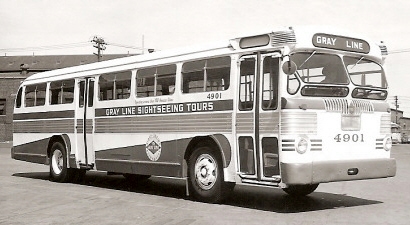
| DSR coach #7150 (a 31-pass coach built by Transit Buses, Inc. in 1949) is seen here decked-out in the red, white and blue Gray Line color decor. This photo was taken atop the Ambassador Bridge, which connects Detroit with Windsor (Canada) across the Detroit River—one of the few locations in the U.S. where one can travel "south" to Canada. Detroit's Gray Line service included a tour into Windsor, Ontario, Canada via The Ambassador Bridge and The Fleetway Tunnel. (Online Photo: collection source unknown) |
|

Unfortunately, as Detroit's reputation continued to deteriorate during the 1980s, interest in Gray Line tour service
declined dramatically. By the 1990s, very little promotion of the service existed, consequently very few patrons took
advantage of the service. In 2003 — after seventy years of providing guided Gray Line tours to various places of
interest in Detroit — the Detroit Department of Transportation and the City of Detroit's long affiliation with Gray
Line Tours quietly came to a close. Sadly, the termination of this service in Detroit practically went unnoticed. No
doubt, a number of factors helped to contribute to the elimination of the service, but with ridership numbers extremely
low, it was no longer financially feasible to continue the service.
declined dramatically. By the 1990s, very little promotion of the service existed, consequently very few patrons took
advantage of the service. In 2003 — after seventy years of providing guided Gray Line tours to various places of
interest in Detroit — the Detroit Department of Transportation and the City of Detroit's long affiliation with Gray
Line Tours quietly came to a close. Sadly, the termination of this service in Detroit practically went unnoticed. No
doubt, a number of factors helped to contribute to the elimination of the service, but with ridership numbers extremely
low, it was no longer financially feasible to continue the service.
Today, Gray Line Worldwide Tours is widely recognized and respected as the world's largest sightseeing tour
company, serving more than 200 destinations worldwide. But sadly, the Detroit is no longer one of those destinations.
company, serving more than 200 destinations worldwide. But sadly, the Detroit is no longer one of those destinations.

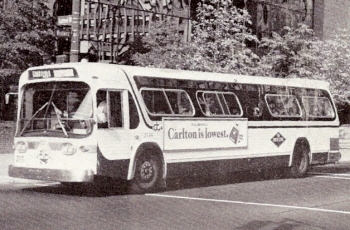
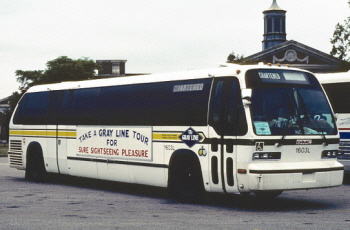
| During the 1960's the DSR used coaches from two fleets of air-conditioned GM "new-looks" for Gray Line operation. Coach #2301 was one of 20 GM coaches (model TDH-5303) purchased in 1966. DSR Gray Line coaches were lettered "GRAY LINE SIGHTSEEING TOURS," but were not specially painted for the service. (photo courtesy of the Krambles-Peterson archive collection: G. Mac Sebree photo) |
|
Information for the above article was complied from various sources: including the Aug-Sep 1955 edition of The D.S.R. Reporter in an
article entitled "Want to see the town? Try a Gray Line Tour!" (pgs 10-11); the Journal of the Common Council – City of Detroit -1947
(both of which courtesy of Stan Sycko); Motor Bus Society's Motor Coach Age magazine article "Detroit's DSR, Part 3" (May-June
1993 edition - by Jack E. Schramm); and from DSR "take-one" cards already in author's possession.
article entitled "Want to see the town? Try a Gray Line Tour!" (pgs 10-11); the Journal of the Common Council – City of Detroit -1947
(both of which courtesy of Stan Sycko); Motor Bus Society's Motor Coach Age magazine article "Detroit's DSR, Part 3" (May-June
1993 edition - by Jack E. Schramm); and from DSR "take-one" cards already in author's possession.
| The unique website which takes a detailed look back at the History of Public Transportation in and around the City of Detroit. |
| . |
ATTENTION VISITORS: Certain browsers and operating systems, particularly with Mac PCs, may distort the layout of this web-page. It is recommended this
page be viewed using recent versions of Internet Explorer and/or Windows (OS). Changing the default (medium) text size will also affect how page displays.
page be viewed using recent versions of Internet Explorer and/or Windows (OS). Changing the default (medium) text size will also affect how page displays.