| . |
| . |
| . |
| . |
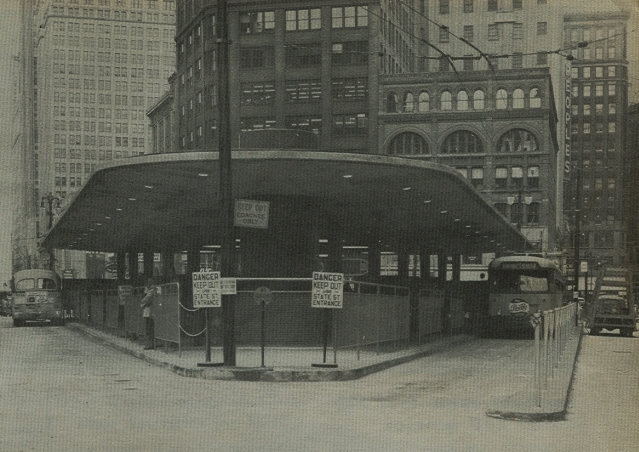
| THE FORMER D.S.R. CAPITOL PARK BUS STATION |
| . |
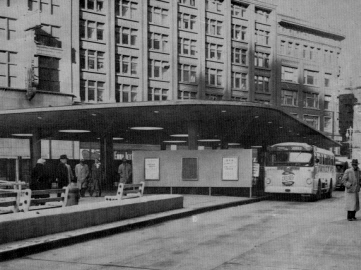
| The above photo shows the former DSR Capitol Park bus station, which was built in 1955. Taken from the north end, this photo shows the loading lanes for the Fenkell and Linwood buses on the left, and the Grand River electric "trackless" trolley-coaches on the right. (Photo source: D.S.R. Reporter, January 1956 edition) |
| Unless otherwise noted, all photos displayed within this article are courtesy of the January 1956 edition of the D.S.R. Reporter, via the Stan Sycko Transit Collection. |
| Click here to return to the "MISCELLANEOUS TOPICS" Main Page. |

| For Comments & Suggestions Please Contact Site Owner at: admin@detroittransithistory.info |
|
[RECONSTRUCTION UPDATE: On October 27, 2010, after 55 years, Governor Stevens T. Mason's tomb was returned to the north end of Capitol Park]
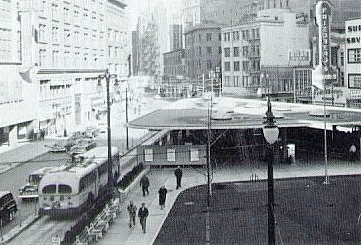
According to the January 1956 edition of The DSR Reporter (an employee newspaper), the shelter was constructed of "...concrete reinforced with steel. The overhead canopy, which took 400 yards of concrete, was poured in one day." Plastic sky domes were used to admit daylight underneath the canopy during the day, while "cold-cathode" (fluorescent) lights would give off a glow affect at night. The only area of the shelter completely enclosed were the ticket office, located on the north end, and the lavatories, which were located in the basement.
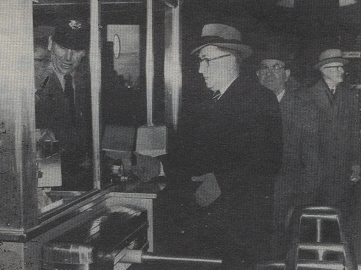
The DSR estimated that over 700 buses and trolley-coaches picked-up over 23,000 passengers from the Capitol Park Station every weekday. With high frequency lines, such as Grand River, operating through the station with one-minute headways, the DSR implemented a "prepay" fare collection system to help speed up the loading operation. During rush hours, riders would pay their fares at manned turnstile booths. With the fare already paid, the passengers would then go directly on board the buses through both doors, which also helped to speed up service.
|
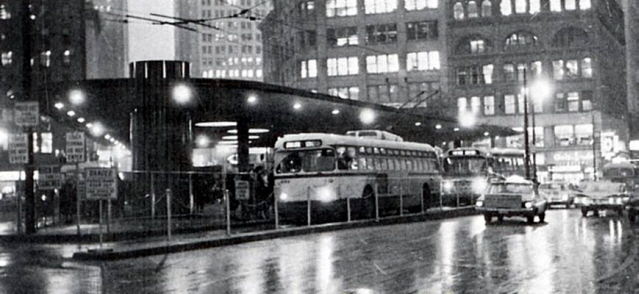
| This photo shows the Capitol Park Terminal on Friday, November 16, 1962—the last day of electric trolley-coach operation on the Grand River line. A General Motors "new-look" diesel coach—the impending replacement for these electric powered buses—can be seen following behind one of the last trolley-coaches to operate in Detroit. (Scalzo Collection Photo, courtesy of Tom's Trolley Coach Pictures at www.trolleybuses.net) |
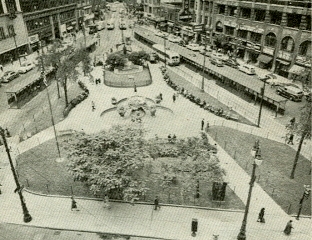
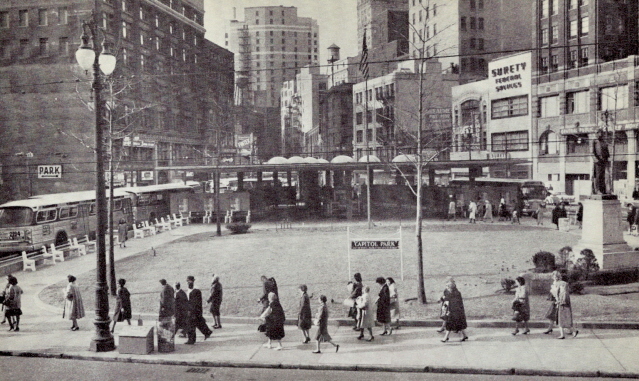
| This early 1960s photo looks north toward the Capitol Park Bus Station from State Street. By the time this photo was taken electric bus operation on the Grand River line had been discontinued, and replaced by GM diesel buses. The statue and tomb of former Michigan Governor Stevens T. Mason can be seen along the south end of the park. (Photo source: General Motors Truck & Coach promotional brochure) |
 | |  | |  | |  | |  |
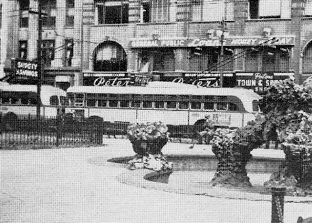
The park's history goes back to when the original state capitol building resided on the site. After the building (then used as a high school) was destroyed by fire in 1893, the triangular–shaped block where the capitol once stood was converted into a park and named, "Capitol Park." The downtown park was lined with rows of park benches, and even had its own water fountain and pool. To accommodate the large rush hour crowds that would gather to board the streetcars, large loading platforms were eventually built along Shelby and Griswold streets.
In early 1953, the DSR released a proposal plan to remodel the park by building a new reinforced concrete bus station, which would offer protection from the wind, rain, and snow for the thousands of DSR passengers who used the location daily. The proposed station would also provide the DSR with a much larger loading area to handle the large volume of crowds.
However, considerable opposition resulted after DSR plans revealed that the proposed shelter would require moving the statue and tomb of Michigan's first governor, Stevens T. Mason, located at the north end of the park. Suggestions to instead enlarge the existing loading zones along the edge of the park were rejected, based on the grounds that it would further reduce the width of the surrounding narrow streets. In addition, the loading zones were considered unsafe, as they placed passengers between the flow of both automobile and bus traffic.
But after less than 25 years of operation, city officials decided that the Capitol Park bus station had out-lived its usefulness. By late 1979, the bus shelter had been demolished and the park redesigned into a more open city-park like setting, similar to its appearance during the years prior to the arrival of the bus station. However, the park would still be used as a layover stop for a number of DDOT routes, including the #25 Jefferson and #38 Plymouth lines.
Beginning Dec. 22, 2001, the Capitol Park area would become the city's new major transit hub after the former DDOT Cadillac Square Transit Center was closed to make way for the city's new Campus Martius Park Project. Initial plans called for the Capitol Park Transit Center to become the "temporary" downtown transit hub, while DDOT awaited the construction of its new transit center located near Michigan Avenue and Cass in Times Square, which was scheduled to be completed sometime in 2005.


| .. |
| The unique website which takes a detailed look back at the History of Public Transportation in and around the City of Detroit. |

| . |

| PRINTER- FRIENDLY WEB-PAGE |
| (Reformatted 01-18-14) |