| . |
Well, because of the influence of the DSR and others, the proposed high-speed rail lines operating along wide central malls within the center median of the expressways were never built. However, neither were the special bus ramps or downtown underground bus terminals. What resulted were a number of so-called "bus interchange" or bus boarding stations that were incorporated along the Edsel B. Ford (Crosstown) Expressway. What may be a surprise to many is that the forgotten remnants of some of these former freeway bus stops, or "rapid transit" boarding stations, are still in existence today.
| . |
| . |
Similar boarding stations were located along the Ford Expressway–Grand River exits. Eastbound coaches would exit at the Grand River (Maybury Grand) exit, while westbound coaches would exit at the Grand River (Linwood) exit. Although I've been unable to uncover additional information on this particular boarding station, aerial photos seem to suggest that express coaches also re-entered the expressway via special bus only lanes. When the Dexter and Grand River Express routes were routed along the Ford and Lodge Expressways for a short period beginning in 1955, these boarding stations were used by both routes to enter and exit the Ford. However, this entire area was later completely redesigned with the addition of the Jeffries (I-96) and Ford (I-94) interchange, which was built during the early 1970s.
| . |
| EDSEL B. FORD (I-94) EXPRESSWAY BUS STOPS |
| . |

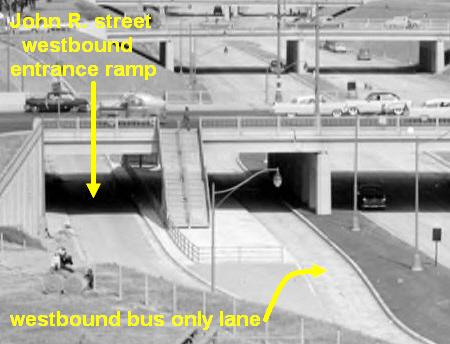
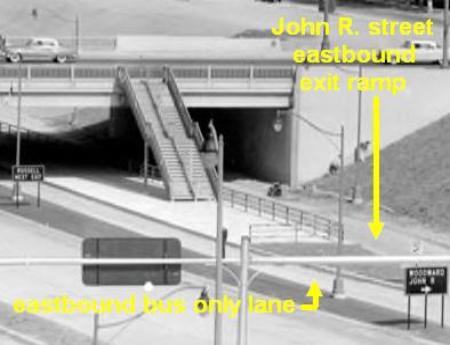
| When the Edsel Ford (I-94) Expressway was being constructed during the early 1950s, plans called for constructing four stairways to be built from the Woodward overpass leading to the expressway below. These stairways were part of a rapid transit plan where passengers boarded DSR coaches from expressway level bus boarding stations. Unfortunately, the end result became a "Stairway to Nowhere!" (MDOT photo) |
| . |
|
Nowhere" (December 20, 1955); miscellaneous Detroit Free Press news articles; Detroit's DSR, Part 3 by Jack E. Schramm
(May-June 1993 MCA); and the Detroit Transportation Board's 1945 Detroit Expressway and Transit System Report (posted at
DetroitYES! Archives). Express bus route information courtesy of "DSR BUS ROUTES, 1945-1975" (May-June 1993 edition of Motor
Coach Age magazine, pgs.30-40).
| Click here to return to the "AROUND OLD DETROIT" Main Page. |

| For Comments & Suggestions Please Contact Site Owner at: admin@detroittransithistory.info |
"...with the opening of new stretches of the Ford and Lodge expressways and the completion of the Ford-Lodge interchange, DSR buses will be able to move with a speed and ease unmatched by subways or other rapid transit systems now in existence elsewhere."
Shortly afterward, the DSR launched its new Plymouth Express bus service on Monday, January 31, 1955. The Plymouth Express would become the first DSR bus route to operate along "two" Detroit expressways, and the first to utilize the new Ford-Lodge Interchange — portions of which first opened on January 18, 1955. A Detroit Free Press article regarding the new service stated....
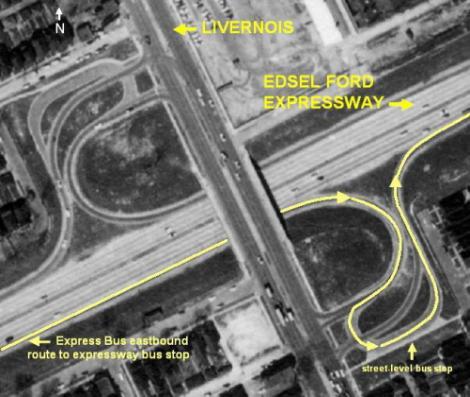
"...From [the Ford Expressway] patrons are whisked downtown in a record 13 minutes, including two stops for passengers at Livernois and Grand River where special loading stations are incorporated in the Ford Expressway."
Many may be surprised to learn that the remnants of one of these "special loading stations" can still be found today along the Edsel Ford (I-94) Freeway, nearly sixty years later.
| . |
| ||||||||
So what did Detroiters receive after all those post-WWII promises? Of course a number of the freeways were built, but as far as mass transit goes, Detroiters received a couple of unused stairs, winding exit ramps, and a few deserted bus lanes. OH WOW!!!
| . |
| |||||||||||


| . |
| The short video clip to the left follows D.S.R. GM diesel coach #1300 as it exits the eastbound Edsel B. Ford Expressway to the street level boarding station which was at one time located along the Livernois Avenue exit and entrance ramps. In this video clip, filmed in the summer of 1955, the coach follows along the path highlighted in the aerial photo above. From January 31, 1955 through November 21, 1955, this special loading station, incorporated into the Ford Expressway, was serviced by the DSR's new Plymouth Express bus route. This exit ramp was later redesigned into its current configuration sometime during the early-to-mid-sixties. |

| Video-clip duration: 01:03 |
| (video added 07/26/08) |
| VIDEO CLIP: FORD EXPRESSWAY AT LIVERNOIS STOP |
| To view a slightly longer video clip, which also includes this segment and just a bit more, visit the web-page: THE HISTORY OF EXPRESSWAY BUS SERVICE IN DETROIT |

 | |  | |  | |  | |  |


| .. |

| Preserving the History of Public Transportation in and around the City of Detroit, ...from "Steel Wheels to Rubber Tires." |
Proposals by the Wayne County Road Commission, the City Plan Commission, and others were also submitted.
Finally, in February of 1945, a detailed study developed for the Detroit Transportation Board was released. The document was titled, "Detroit Expressway and Transit System," and included proposals to build a complex expressway network and a bus and rail rapid transit system across the city of Detroit.
In addition to a major expressway network, the committee also released its findings on mass transit. The study proposed utilizing multiple-unit PCC streetcars operating as high-speed trains within the central mall portion of the entire Crosstown Expressway, and along certain portions of the Grand River Expressway. The plan called for maintaining streetcar operation on Woodward Avenue, but converting the existing streetcars lines on Fort, Gratiot, Jefferson and Michigan over to electric trolley-buses. Upon reaching the downtown central business district, all streetcars and trolley-buses would then dip below ground and operate via a subway. A number of underground stations were also planned for the downtown subway route, terminating at a new underground plaza, which would be built underneath Cadillac Square. In addition, larger-size express buses were proposed for routes along Grand River and Gratiot, that would travel along the proposed Crosstown, Grand River and Hastings Expressways.
| . |
| . |
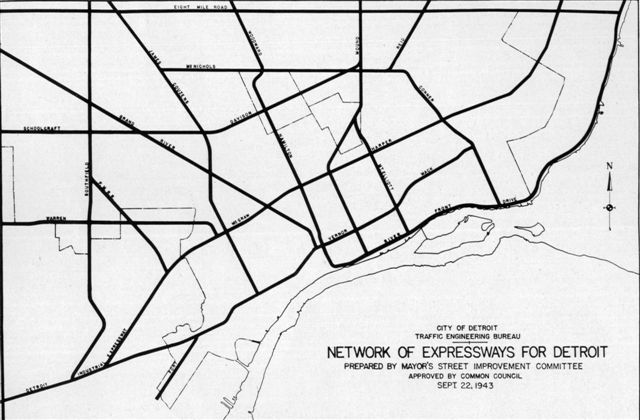
| The above map shows the initial expressway plan released by Mayor Jeffries' Street Improvement Committee in Sept 1943. With the exception of the Ford and Southfield expressways, and some portions of the Lodge, Chrysler and Fisher, most of these proposed expressways were never built. (photo courtesy of DetroitYES.com) |
Instead, the DSR pushed for an alternative expressway plan that only included a network of high-speed bus routes operating along the city's expressway network. These buses would then exit via exclusive bus ramps to four downtown underground terminals. The DSR plan also called for the construction of several bus interchange stations to be built along the expressways themselves — an idea opposed by the engineers who prepared the Detroit Transportation Board report. The DSR report considered the high-speed bus plan "a superior type of rapid transit" and more economically feasible.
| . |
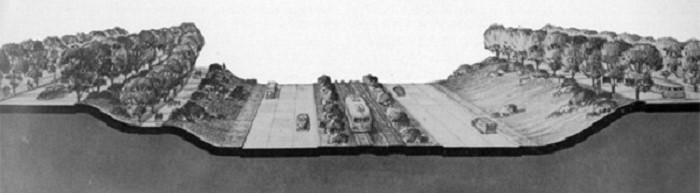
| The 1945 Detroit Transportation Board plan included this cut-away drawing illustrating how the proposed Crosstown and Grand River expressways would provide for rapid transit rail cars operating within the planted dividing median mall of the expressway. The Detroit DSR opposed this and any proposal that included streetcars. (courtesy of DetroitYES.com) |
In an attempt to accommodate the DSR's vision of providing Detroiters "rapid transit" service through the use of express buses operating along the city's expressways, the stairs were to be used by DSR passengers moving to and from bus loading stations at the expressway level. The plan was that a new east-west express route would be started along the Ford Expressway.
Special bus lanes were incorporated into the expressway to access the bus loading stations that were located at the foot of the stairways. Express buses would enter the waiting area via the special bus lanes, board passengers waiting at the station, and then re-enter the expressway.
Apparently, the city's plans looked great on paper, but they were never carried out. The stairways would remain unused for nearly five years. With the access blocked off at the Woodward street level, the stairs became a reminder of what could have been.
In a December 20, 1959, Detroit News article titled, "Stairway to Nowhere," the DSR's Superintendent of Transportation Operations, James E. Bostick, was quoted as saying, "...The plan proved to be impractical. Surveys revealed there was not sufficient passenger volume to justify the new line, and it never was started."
Consequently, wrecking crews had to be called to correct the five year old mistake. City officials stated that it was going to cost money to remove the stairs. The stairways were slated to be removed in the spring of 1960.
| . |

| CLICK HERE TO PRINT TEXT–PAGE |
| (Reformatted 10-06-14) |
