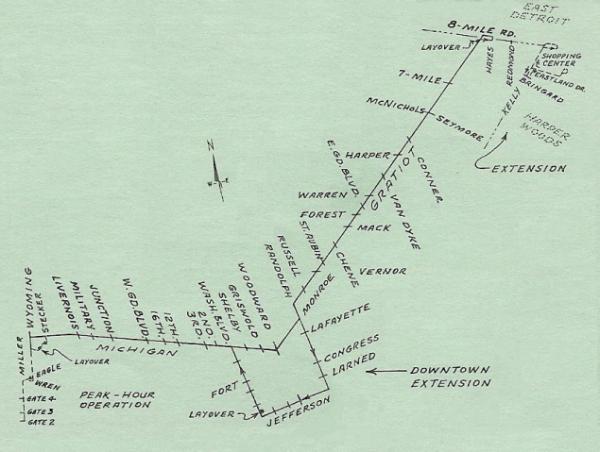
D.S.R. Route #12
| MICHIGAN-GRATIOT |
In early April, 1973, DSR assistant general manager Don Edmondson announced that the DSR would
soon be initiating a plan that could eventually lead to a union of most of the system's 26 bus lines that
terminate downtown. This change would enable a DSR rider to board any one of a number of buses in
northwest Detroit, pay one fare only, then travel through downtown and out to the city's far northeast
side.
According to an April 3, 1973, Detroit Free Press article, the proposed changes would also mean:
The Michigan and Gratiot routes were selected for the first merger partially because the 1970
census showed that the northeast area serviced by the Gratiot line was the area with the city's
highest percentage of workers in the downtown Central Business District (CBD). If no major hitches
were encountered with the merged operation after two or three months, the DSR had planned to also
merge other lines such as the Fort and Oakland, Woodward and Jefferson, and Michigan and
Mack routes.
One example cited in that Free Press article was the Grand River bus line—-were passengers were
dropped off at the Capitol Park terminal on the northwest side of downtown. They were then forced
to transfer or undergo long walks to their jobs while their bus headed back out Grand River. Under
this new plan, however, the bus would proceed through downtown, dropping off riders near their place
of employment and continuing to the northeast. Although the Michigan and Gratiot lines were
combined on June 15, 1973, the plan was never broadened to include other downtown lines.
That following November, the voters of Detroit approved a revised city charter, which resulted in the
financially plagued DSR being reorganized into the Detroit Department of Transportation (DDOT).
No further route mergers resulted during the remaining months under the DSR.
Under DDOT management, new route numbers were assigned to all existing bus lines—-with the
Michigan-Gratiot line becoming route #34 Michigan-Gratiot. On weekdays, headways on
Michigan-Gratiot averaged 4 minutes during the peak hours, and 7-minute headways during the
base and evening hours. An east-side route #75 Gratiot Express also operated weekdays during
the AM and PM peak hours, with 6–8 minute headways between 3rd and Porter streets downtown, to
either East Eight Mile Road and Gratiot, or the Eastland Mall Shopping Center.
Meanwhile, under the new DDOT management, the downtown through-routing plan for additional
routes was never implemented. Instead the reverse resulted, when on Saturday, April 15, 1978, the
Michigan and Gratiot routes were again separated after major service interruptions resulted when
coach and manpower shortages occurred at the two terminals which serviced the combined routes.
Major service gaps were encountered during the winter of 1977-78, as the department experienced its
worse on-time performance up to that time in its history. The two routes were again separated in order
that the two terminals could better manage their individual lines.
After the two lines were separated, the Gratiot line retained its #34 route number designation, while
the Michigan line was reassigned as route #37 Michigan. This new reassignment resulted in those
DDOT routes starting from route #37 Plymouth now having to be reassigned one route number
higher. Consequently, the former route #37 Plymouth became the current #38 Plymouth, while the
former #53 Wyoming became the current #54 Wyoming. (see DDOT Routes & Numbers)
On an interesting footnote, a number of DDOT bus routes (including some mentioned earlier) were
later combined for similar reasons expressed years earlier by former DSR management. Effective on
September 5, 1992, the DDOT Baker and Oakland, Joy Road and E. Vernor, Woodward and E.
Jefferson, and once again, the Gratiot and Michigan lines were combined and through-routed into
and out of downtown.
Information for the above article compiled from numerous sources, including "Detroit's DSR, Part 3" — May–June 1993 edition of Motor
Coach Age (MCA). Additional information acquired from miscellaneous DSR and DDOT Service Maps already in the author's
possession, and from the April 3, 1973, Detroit Free Press article titled "DSR Plans Link Of East and West," courtesy of the Stan Sycko
Collection. The Michigan-Gratiot 1977 transfer also courtesy of the Stan Sycko collection.
soon be initiating a plan that could eventually lead to a union of most of the system's 26 bus lines that
terminate downtown. This change would enable a DSR rider to board any one of a number of buses in
northwest Detroit, pay one fare only, then travel through downtown and out to the city's far northeast
side.
According to an April 3, 1973, Detroit Free Press article, the proposed changes would also mean:
- An end to the long walks by downtown employees who at present may be dropped off by a west
side line on the west side of downtown and must walk, sometimes in heavy winter snow, to their
jobs on the east side of downtown. - An end to the use of the main street in Greektown, Monroe between Randolph and St. Antoine,
by all but minibuses. - Fewer buses clogging the downtown area and a 50 percent cut in the number of buses
crossing Woodward Ave. - A saving of up to $1 million a year for the deficit-ridden DSR if all possible lines are merged.
The money would be saved by eliminating overlapping mileage.
The Michigan and Gratiot routes were selected for the first merger partially because the 1970
census showed that the northeast area serviced by the Gratiot line was the area with the city's
highest percentage of workers in the downtown Central Business District (CBD). If no major hitches
were encountered with the merged operation after two or three months, the DSR had planned to also
merge other lines such as the Fort and Oakland, Woodward and Jefferson, and Michigan and
Mack routes.
One example cited in that Free Press article was the Grand River bus line—-were passengers were
dropped off at the Capitol Park terminal on the northwest side of downtown. They were then forced
to transfer or undergo long walks to their jobs while their bus headed back out Grand River. Under
this new plan, however, the bus would proceed through downtown, dropping off riders near their place
of employment and continuing to the northeast. Although the Michigan and Gratiot lines were
combined on June 15, 1973, the plan was never broadened to include other downtown lines.
That following November, the voters of Detroit approved a revised city charter, which resulted in the
financially plagued DSR being reorganized into the Detroit Department of Transportation (DDOT).
No further route mergers resulted during the remaining months under the DSR.
Under DDOT management, new route numbers were assigned to all existing bus lines—-with the
Michigan-Gratiot line becoming route #34 Michigan-Gratiot. On weekdays, headways on
Michigan-Gratiot averaged 4 minutes during the peak hours, and 7-minute headways during the
base and evening hours. An east-side route #75 Gratiot Express also operated weekdays during
the AM and PM peak hours, with 6–8 minute headways between 3rd and Porter streets downtown, to
either East Eight Mile Road and Gratiot, or the Eastland Mall Shopping Center.
Meanwhile, under the new DDOT management, the downtown through-routing plan for additional
routes was never implemented. Instead the reverse resulted, when on Saturday, April 15, 1978, the
Michigan and Gratiot routes were again separated after major service interruptions resulted when
coach and manpower shortages occurred at the two terminals which serviced the combined routes.
Major service gaps were encountered during the winter of 1977-78, as the department experienced its
worse on-time performance up to that time in its history. The two routes were again separated in order
that the two terminals could better manage their individual lines.
After the two lines were separated, the Gratiot line retained its #34 route number designation, while
the Michigan line was reassigned as route #37 Michigan. This new reassignment resulted in those
DDOT routes starting from route #37 Plymouth now having to be reassigned one route number
higher. Consequently, the former route #37 Plymouth became the current #38 Plymouth, while the
former #53 Wyoming became the current #54 Wyoming. (see DDOT Routes & Numbers)
On an interesting footnote, a number of DDOT bus routes (including some mentioned earlier) were
later combined for similar reasons expressed years earlier by former DSR management. Effective on
September 5, 1992, the DDOT Baker and Oakland, Joy Road and E. Vernor, Woodward and E.
Jefferson, and once again, the Gratiot and Michigan lines were combined and through-routed into
and out of downtown.
Information for the above article compiled from numerous sources, including "Detroit's DSR, Part 3" — May–June 1993 edition of Motor
Coach Age (MCA). Additional information acquired from miscellaneous DSR and DDOT Service Maps already in the author's
possession, and from the April 3, 1973, Detroit Free Press article titled "DSR Plans Link Of East and West," courtesy of the Stan Sycko
Collection. The Michigan-Gratiot 1977 transfer also courtesy of the Stan Sycko collection.
© 2008
| D-DOT Route #34 (Express Route #75) |
Three times in the history of public transit in Detroit, the Michigan and Gratiot lines have been
combined to create one continuous route. The first of these occurred back on November 13, 1950,
when the Michigan and Gratiot PCC streetcar lines were consolidated and through-routed thru
downtown Detroit. The newly merged route resulted in a 16.7 mile long one-way trip from the
Eastwood (Amusment) Park, located on Gratiot north of E. Eight Mile in East Detroit (now Eastointe),
to the Ford Rouge-DSR Miller Road Yard in Dearborn. This combined operation lasted until the
Michigan Avenue portion of the route was converted over to diesel bus operation beginning on
Wednesday, September 7, 1955, and the two lines became separated, with PCC service still
continuing for six months along Gratiot Avenue.
The next time these lines would be combined would be on Friday, June 15, 1973, during one of the
last major route adjustments implemented under the former DSR operation. Beginning on that day,
DSR routes #12 Michigan and #25 Gratiot were merged, forming the combined route #12
Michigan-Gratiot.
combined to create one continuous route. The first of these occurred back on November 13, 1950,
when the Michigan and Gratiot PCC streetcar lines were consolidated and through-routed thru
downtown Detroit. The newly merged route resulted in a 16.7 mile long one-way trip from the
Eastwood (Amusment) Park, located on Gratiot north of E. Eight Mile in East Detroit (now Eastointe),
to the Ford Rouge-DSR Miller Road Yard in Dearborn. This combined operation lasted until the
Michigan Avenue portion of the route was converted over to diesel bus operation beginning on
Wednesday, September 7, 1955, and the two lines became separated, with PCC service still
continuing for six months along Gratiot Avenue.
The next time these lines would be combined would be on Friday, June 15, 1973, during one of the
last major route adjustments implemented under the former DSR operation. Beginning on that day,
DSR routes #12 Michigan and #25 Gratiot were merged, forming the combined route #12
Michigan-Gratiot.