| . |
| . |
| D-DOT Route #78 |
| IMPERIAL EXPRESS "LIMITED" |
News and Free Press newsarticles (May 1958); route data supplied by Jack E. Schramm, courtesy of "DSR Bus Routes, 1945-1975" (May-June 1993 edition
of Motor Coach Age magazine), in addition to information supplied by DDOT Senior Service Inspector Dennis Grooms – posted at the "DSR-2-DOT" Yahoo!
discussion group. Additional info compiled from miscellaneous DDOT Route Service Maps and various DDOT service adjustment bulletins in the author's
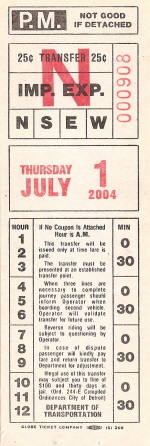
possession. All Imperial Expresss transfers courtesy of the Stanley Sycko Collection.
| Click here to return to the "BUS ROUTE HISTORY" Main Page. |
However, also effective that day, a few peak-hour trips were routed to Eight Mile Road and Grand River. This service would branch off Seven Mile Road at Lasher and run north to Eight Mile, then west to Inkster Road, looping at Grand River. This branch operation was the result of the Imperial Express replacing portions of the Eight Mile West bus line, which was also discontinued on Sept. 7, 1966. In addition, some morning and afternoon trips were operated as a shuttle service, following the entire Eight Mile West route, from McNichols and Lahser, via Lahser and Eight Mile Road to Grand River. Two 5¢ zone fares were also collected along Eight Mile Road, outside the city limits.
Also in 1966, the DSR began assigning route numbers to its bus routes. The Seven Mile Road express route would now become route #44 Imperial Express.
| . |
|


THE EARLY D-DOT YEARS:
By the time the DSR was reorganized as DDOT in 1974, headways had increased slightly, and now averaged 4 to 6 minutes during peak hours and 28 minutes during midday hours. In 1975, DDOT would assign new route number to all its routes, with route #44 Imperial Express becoming DDOT route #78 Imperial Express. During the DDOT years, a number of route and service improvements were actually made to the Imperial line. But unfortunately, even the grand "Imperial" name couldn't escape the line from the impending service reductions that would later follow.
During the late-1980s, service along Seven Mile was extended eight miles west to Northville Psychiatric Hospital in Northville (west of Haggerty Road), which would also include providing service into the Livonia Mall at Seven Mile and Middlebelt roads. DDOT would still continue to use its Imperial Express coaches to provide the shuttle service between Lahser and McNichols to Eight Mile and Grand River (Inkster Road) during the AM and PM rush hours — in addition to its branch service via Lahser to Eight Mile and Grand River. The Imperial coaches also began providing evening shuttle service along Seven Mile Road between the Livonia Mall and Grand River. This service operated between the hours of 5:30 and 9:30 p.m. after the regular express operation had ended for the day.
Since the first day service was launched back in May 1958 — when GM "old-look" coaches were first used to service the line — the Imperial Express route has been serviced primarily by 40-foot coaches. However, beginning in the fall of 1989, one of the 60-foot, 65-passenger Neoplan "articulated" coaches (#8900-8913) saw service on the Imperial line. However, this service was short-lived, as the "artic" coaches were eventually used on other lines.
By the 1990s, headways now averaged 10 mins during AM peak, 15 mins during PM, and 20 mins during the off-peak hours. But the 1990s would also see the beginning of the steady downward decline in Imperial Express service. Effective, Tuesday, Sept. 8, 1992, the extended trips along Seven Mile Road to the Northville Hospital in Northville were discontinued, and the route now terminated at the Livonia Mall. This continued until major route changes implemented by DDOT took effect beginning June 25, 1994, and Imperial Express service along Seven Mile Road was again cut back — this time to the city limits at Seven Mile and Grand River.
| © 2006 (PAGE LAST MODIFIED ON 08-18-07 (addition 03-12-12), 10-20-14) |
THE LATER D-DOT YEARS:
It might also be noted, that toward the late 1980s, DDOT began operating a slightly different type of express service. Although some "Express" routes remained, many were now being designated as "Limited" service routes — a semi-express with a basic fare. By the mid-1990s, the few remaining express routes, including the Imperial Express, were now "Limited" routes, with boarding and exiting only at predetermined stops.
Although the "Imperial Limited" continued operations, the service definitely began falling on hard times, as system-wide service reductions implemented by DDOT over the years would continue to affect service. Consequently, as the ridership numbers fell, the headways would continue to increase. By 1992, service operated only during peak hours, however, midday service was again restored in 1996. By 1997, headways had increased to 15 minutes during peak hours, and 30 minutes during midday hours.
Unfortunately, the downward trend continued. By the mid-2000s, service had diminished to 20 to 30 minute headways, and only operated during the peak service hours of 5:00 to 10:00 a.m. and 3:00 to 7:30 p.m. In addition, only two rush hour trips were made over the former Eight Mile West bus route — operating only as far west as the Detroit city limits at Eight Mile Road and Five Points.
| . |

| The above map shows a later version of DDOT Route #78 IMPERIAL LIMITED. Once coined Detroit's answer to Rapid Transit, the route no longer exists today. |
THE D.S.R. YEARS:
Initially, the Imperial Northwest Express provided service from Seven Mile and Inkster Roads in Redford Township to the recently completed City-County Building in downtown Detroit. The coaches traveled via W. Seven Mile Road, then southward along James Couzens Highway, which then connected with the new John C. Lodge Expressway at the Wyoming curve; where the coaches began their expressway operation. After exiting the Lodge at Temple, the buses traveled via Temple, Third, Henry, Woodward and Larned streets to the City-County Building at Randolph.
In the beginning, the Imperial coaches operated every ten minutes during peak hours and 30 minutes during off-peak hours; Monday through Friday. Although a special express bus zone-fare was implemented initially — where fares varied from 45¢ to 25¢ — the previous 25¢ fare (5¢ over the regular fare) was reinstated on August 11. However, a 5¢ fare increase by the DSR on July 1, 1959, would result in the express fare increasing to 30¢.
During the early sixties, work began on transforming the scenic James Couzens Highway north of Wyoming into the James Couzens Expressway — which was constructed right through the center median of that wide super-highway. Meanwhile, the Imperial coaches would continue to enter and exit the Lodge at Wyoming, operating locally along the service drive. The former James Couzens Highway now served as the new expressway's service drive. Also by the early sixties, many DSR publications began referring to the line as the "Seven Mile Imperial Express."
| . |
| . |
| . |

| THE END OF AN ERA IN DETROIT TRANSIT |
city of Detroit has come to a close. The implementation by DDOT of
service cutbacks, effective Saturday, March 3, 2012, brought an end
to nearly 54 years of service on Route #78 Imperial Limited. The
Imperial line had been the last expressway bus route left operating
in the city, a service first launched by the Detroit DSR system back
on December 4, 1950. Eight years later, the DSR would launch its
"de luxe" expressway route; the Imperial Express.
Randolph at 4:15 p.m. while working route #78 Imperial Limited on
the route's last day of operation, Friday, March 2, 2012.
| . |

| CLICK HERE TO PRINT TEXT-PAGE |
| (Reformatted 10-20-14) |
| . |
| . |

| On the opening-day of the Imperial Northwest Express, special signs prepared by the DSR paint shop were fitted onto each coach, inviting riders to try out the new bus service. Kathaleen Pittel, one of the hostesses that greeted passengers that day, poses beside one of the Imperial buses sporting the large signs. (photo courtesy of the DSR Reporter – May-June 1958 edition) |
The former DDOT route #78 Imperial Limited had its beginnings — amid much media hype — back on Monday, May 26, 1958. Free rides, refreshments, pretty hostesses, and even a bus decked out in red carpeting, all helped to usher in the new route. Originally known as the "Imperial Northwest Express," the Detroit DSR promoted this line as its alternative to "rapid transit" — sort of like a Detroit sub-way service, so to speak. This new "rapid transit" route was the longest DSR route to travel along an expressway (nearly 7-½ miles), and was promoted as the "Deluxe" line among the city's express routes. Supposedly, a new era in Detroit "rapid transit" bus service was being launched.
Around six o'clock that first morning, fourteen sparkling clean "large-capacity" GM diesel coaches — all loaded with boxes of donuts, potato chips and milk (provided by DSR advertisers Farmcrest, Vita Boy and Wilson's Dairy) — were ready and waiting at the Gilbert Terminal yard to launch the DSR's fast, new express bus service. After the young attractive hostesses were hurried on board — each dressed as if going to a ball — the buses swung off the property and headed to their destinations. "The Imperial Express was now on its way!"
The first bus in the group — which sported thick, red carpeting along the floor and steps — arrived at W. Seven Mile and Grand River at 7:45 a.m. Waiting to board that inaugural bus was Detroit Mayor Louis C. Miriani, along with DSR general manager Leo J. Nowicki, members of the DSR Commission, the Northwest Lions Club, and the city's Municipal Parking director. Also on board was Barbara Gruendler, the Miss DSR for May, who passed out free doughnuts, milk and orange juice to the riders. The inaugural bus arrived at the City-County Bldg at 8:40 a.m.
| . |
| . |
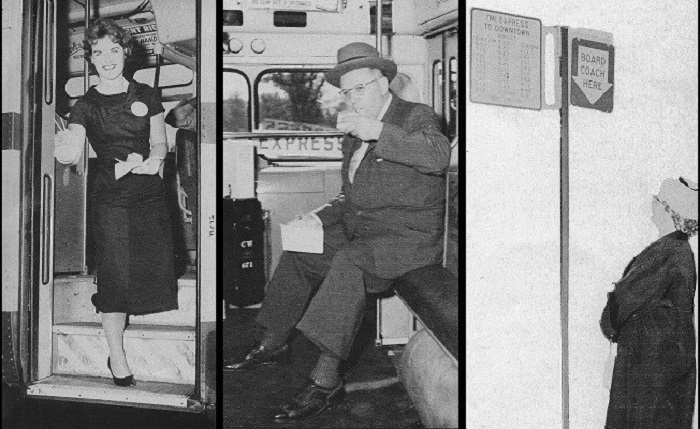
| left photo: Hostess Shirley Delorme welcomes riders on the first day. center photo: Mayor Miriani sips milk on inaugural bus. right photo: Metal schedule signs were erected along W. Seven Mile at all transfer points between Inkster Road and Greenfield. (photos courtesy of the DSR Reporter – May-June 1958 edition) |
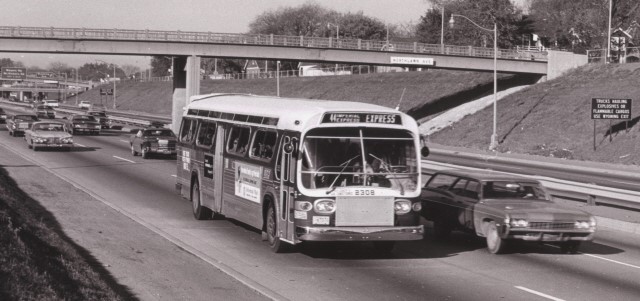
| In this 1968 photo, DSR coach #2308 is southbound along the John C. Lodge Expressway at Northlawn Ave while working the Imperial Express. Coach #2308 was one of twenty "air-conditioned" GM model TDH-5303 3-speed transmission buses (#2301–2320) delivered in early 1966 that were used for high-speed expressway operation. |
For more on the initial launching of the Imperial Express line, and the history of expressway bus service in Detroit, see the related article:
"HISTORY OF EXPRESSWAY BUS OPERATION IN DETROIT."
